Breakthrough in Thermal Photonics Enables Vertical Surface Cooling Below Ambient Temperature
December 3rd, 2024 8:00 AM
By: Newsworthy Staff
A new study published in Science demonstrates a significant advancement in thermal photonics, allowing for efficient subambient daytime radiative cooling on vertical surfaces. This innovation could lead to improved energy efficiency in buildings, vehicles, and clothing.
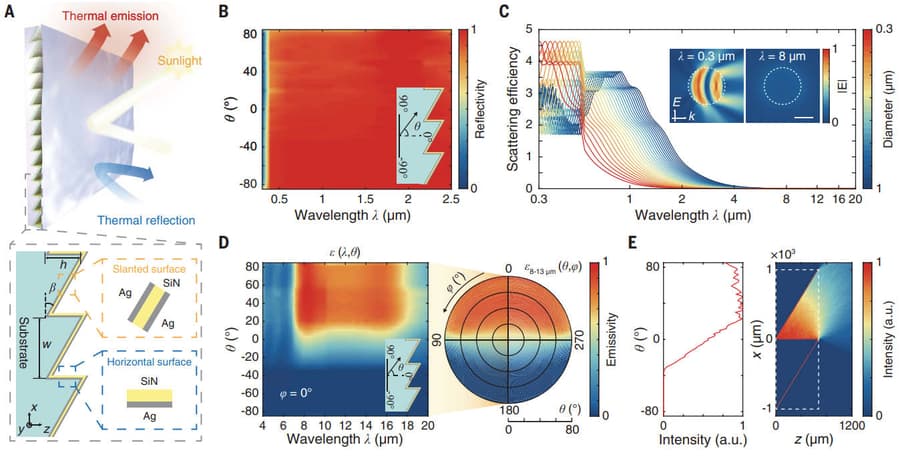
A team of researchers has achieved a significant breakthrough in thermal photonics, enabling efficient subambient daytime radiative cooling for vertical surfaces. The study, published in the prestigious journal Science, represents a major step forward in thermal management and energy efficiency technologies.
Led by Professor Wei Li from the Changchun Institute of Optics, Fine Mechanics and Physics of the Chinese Academy of Sciences, in collaboration with teams from Stanford University and the City University of New York, the researchers developed a novel approach to control thermal radiation in both angle and spectrum. This advancement overcomes the limitations of traditional radiative coolers, which were only effective on horizontal surfaces.
The key to this breakthrough lies in the design of an angularly asymmetric and spectrally selective thermal emitter (AS emitter). This innovative device utilizes a cross-scale symmetry-breaking structure, consisting of a sawtooth grating covered by an ultraviolet-visible reflective, infrared transparent nanoporous polyethylene film. This unique configuration allows for precise control of thermal radiation, enabling cooling even on vertical surfaces exposed to sunlight and heat from surrounding objects.
The implications of this research are far-reaching. Traditional radiative coolers have been limited to horizontal applications due to their omnidirectional thermal radiation properties. When applied to vertical surfaces, these coolers would absorb considerable heat from the ground, surrounding objects, and atmosphere, rendering them ineffective. The new AS emitter design overcomes these challenges, maintaining temperatures below ambient levels even under peak sunlight conditions.
In practical tests, the AS emitter demonstrated remarkable performance, maintaining a temperature 2.5°C below ambient temperature during peak sunlight hours. This represents a significant improvement over conventional high-performance radiative coolers and commercial white paint, with temperature reductions of 4.3°C and 8.9°C respectively.
The flexibility of this design strategy allows for customization based on specific practical scenarios. Even when faced towards a hot building wall, the AS emitter can still achieve subambient radiative cooling, showcasing its versatility and potential for real-world applications.
This breakthrough has significant implications for energy efficiency and sustainability across various industries. The technology could be applied to walls, clothing, vehicles, and other vertical or inclined surfaces, potentially leading to reduced heating costs and lower global energy consumption. As climate change concerns continue to grow, innovations like this play a crucial role in developing more sustainable and energy-efficient solutions.
The research team envisions widespread applications for their design strategy in common real-world scenarios involving inclined or vertical surfaces. This dimensional leap in radiative cooling technology, from horizontal surfaces to practical three-dimensional scenarios, opens up new possibilities in thermal management and energy conservation.
As the world continues to grapple with energy challenges and the need for more sustainable technologies, this breakthrough in thermal photonics represents a significant step forward. By enabling efficient cooling on vertical surfaces, this innovation could contribute to reduced energy consumption in buildings, improved thermal management in vehicles, and more comfortable clothing in hot climates.
The study, supported by grants from the National Natural Science Foundation of China, the US Department of Energy, and a Vannevar Bush Faculty Fellowship, demonstrates the power of international collaboration in scientific research. As further developments in this field emerge, we can expect to see new applications and improvements in energy efficiency across various sectors, contributing to a more sustainable future.
Source Statement
This news article relied primarily on a press release disributed by 24-7 Press Release. You can read the source press release here,