Buncombe County's Migration Reversal After Helene Signals Long-Term Shifts in Western North Carolina
September 20th, 2026 5:50 AM
By: Newsworthy Staff
Buncombe County experienced the steepest domestic migration reversal of any large U.S. county after Tropical Storm Helene, with far more people leaving than arriving, doubling of homes for sale, and a shrinking labor force.
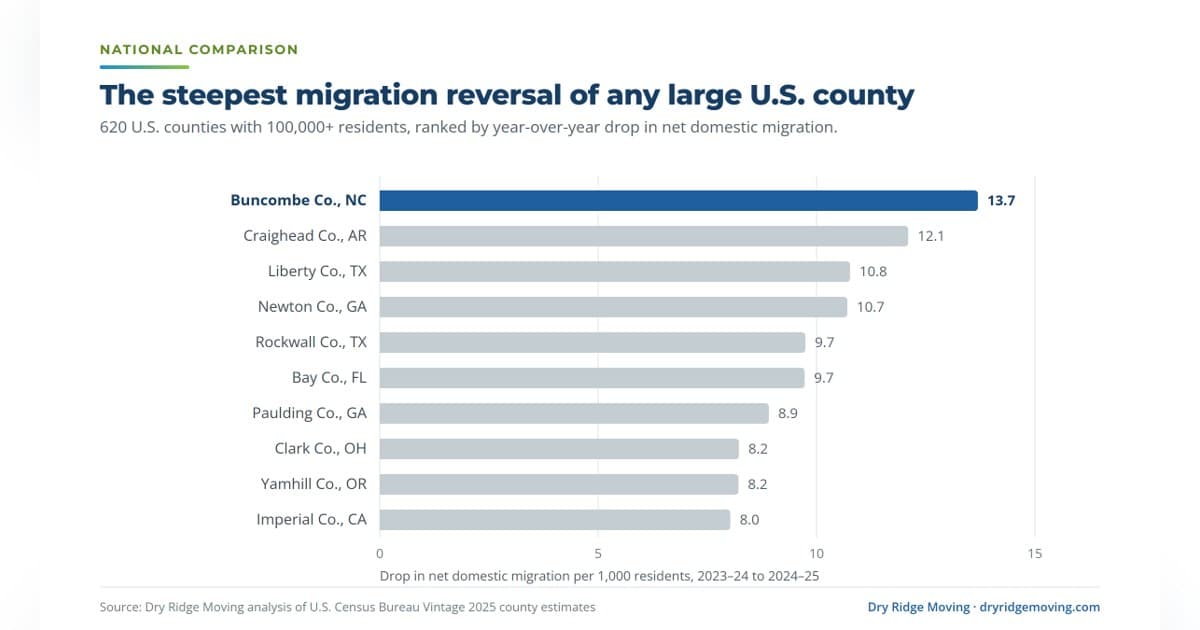
Two years after Tropical Storm Helene struck Western North Carolina, new data reveals that Buncombe County has undergone the most dramatic reversal in domestic migration among all large U.S. counties. According to an analysis by Asheville-based moving company Dry Ridge Moving, the county saw a swing of 13.7 net movers per 1,000 residents between the year before the storm and the year after, the largest such change in the nation. In the year prior to Helene, 1,768 more people moved into Buncombe County from elsewhere in the United States than moved out. In the year following, 2,056 more people left than arrived, resulting in a net loss. This shift contributed to the county’s first annual population decline since at least 2000, with Census estimates showing 1,810 fewer residents in July 2025 than a year earlier.
The housing market has also been transformed. Active home listings in Buncombe County more than doubled from 886 in August 2024 to 1,799 in August 2026, a 103 percent increase, while listings nationally grew only 25 percent. The median time a home spent on the market rose from 54 to 78 days, and Zillow’s typical home value in the county fell 5.6 percent between September 2024 and July 2026, even as national home values rose 1.1 percent. These figures suggest a cooling market that may offer more opportunities for buyers but also reflect reduced demand.
The local workforce has contracted as well. Buncombe County’s civilian labor force stood at 135,287 in July 2026, down 5.8 percent from July 2024, according to preliminary Bureau of Labor Statistics data. By comparison, North Carolina’s statewide labor force fell only 1.2 percent over the same period. The county’s unemployment rate, which spiked after the storm, was 3.4 percent in July 2026, indicating that while jobs may be available, many working-age residents have left the area.
Interestingly, the broader region continued to grow, though at a slower pace. Across 23 Helene-declared counties in North Carolina’s mountains and foothills, net domestic migration fell 54.5 percent, from 9,183 to 4,180, but remained positive. Henderson County, for example, added 1,089 residents. This suggests that while Buncombe County experienced an exodus, other parts of Western North Carolina still attracted new residents.
The migration reversal marks a significant break from historical patterns. IRS data from tax years 2022 and 2023 show that Florida was the leading out-of-state source of new households for Buncombe, Haywood, Henderson, Madison and Transylvania counties, with 1,315 households moving in. South Carolina, particularly Greenville and Spartanburg counties, was the top destination for households leaving the area, with 1,111. The storm appears to have interrupted these established flows, potentially altering the region’s demographic and economic trajectory for years to come.
The study acknowledges that Census estimates are revised annually and may not fully capture temporary displacement, and that 2026 county labor force figures are preliminary. The next county population estimates, expected in spring 2027, will reveal whether the migration reversal persists. For now, the data underscores the profound and lasting impact of Tropical Storm Helene on one of North Carolina’s most vibrant communities. The full study, including methodology, charts and downloadable county data, is available on the Dry Ridge Moving website.
Source Statement
This news article relied primarily on a press release disributed by Press Services. You can read the source press release here,