Cognitive Alignment: The Next Frontier in Human Performance Optimization
September 25th, 2025 3:00 PM
By: Newsworthy Staff
This article explores how shifting from traditional productivity models to cognitive alignment and state-to-task matching can significantly improve performance by accounting for mental readiness rather than just time management.
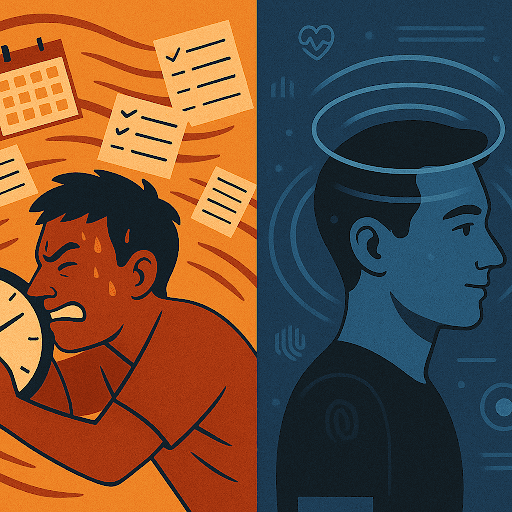
For decades, productivity has been treated as a function of time management, task execution, and personal will. The tools we've built, including calendars, project trackers, and personal operating systems, reflect this assumption. They treat output as a linear product of input: the more hours logged, the more tasks completed, the more successful the day. This model has produced real gains by rewarding discipline, reducing ambiguity, and providing scaffolding for increasingly complex work, but as cognitive demands increase and work shifts from routine execution to open-ended synthesis, the limits of this model have become more visible.
The primary limitation is that most productivity systems assume the mind is ready when the calendar says it is. They optimize for time and process but do not account for cognitive readiness, which often shapes the quality of output more than any to-do list. This unmeasured variable determines whether a writer can clearly express ideas or a strategist can reason through ambiguity, and it's responsible for whether a student can properly retain what they study. When state and task are aligned, humans are often at their best; when misaligned, the opposite happens.
Cognitive performance fluctuates based on sleep, nutrition, stress, distraction, and emotional load, often within a single day or even hour. Yet most people plan their tasks as if the brain will comply automatically on command. The consequences are widespread: individuals blame themselves for underperformance, teams create rigid systems to force consistency, and leaders impose uniform expectations across heterogeneous brains. These strategies fail to address the underlying variable: the fit between the task's demands and the individual's current cognitive state, known as Cognitive Alignment.
Cognitive Alignment is a practical lens for understanding when performance breaks down and how to adjust. A person trying to brainstorm in an anxious state may struggle to access divergent thinking, while a detail-heavy task attempted during cognitive fatigue is likely to introduce errors. These mismatches, often mistaken as moral failures or motivational lapses, are more often simple cognitive mismatches. In the past, they could only be addressed retrospectively through heuristics for self-awareness, but recent advances in machine learning, computer vision, and behavioral science are making real-time intervention possible.
These technologies can detect facial blood flow, heart rate variability, and microexpressions that correlate with cognitive load, stress, and engagement using devices we use every day. They assess cognitive states in seconds and offer lightweight interventions, moving us from brute force productivity to a human-centric model. To support this approach, a structural framework called State-to-Task Matching is essential. This process involves identifying what mental state a task requires, whether the individual is currently in that state, and determining the best next steps if not.
Not all tasks are equal; writing, analysis, strategic planning, interpersonal negotiation, and executional follow-through each demand different cognitive configurations. Some require verbal clarity, while others need working memory, emotional regulation, pattern recognition, or sociability. Attempting the wrong task in the wrong state leads to frustration, waste, and degraded results. With proper mapping, decisions become clearer: should I shift my task or try to shift my state? Should I push forward or pause? Should I spend my best mental window on high-leverage work or email triage?
This refinement is now feasible because AI systems capable of real-time inference of video are mature enough to be embedded into daily workflows. They can detect when cognitive drift begins and respond without being intrusive, acting as perceptual layers that track the brain's readiness and surface signals only when they matter. This represents a different model of intelligence that helps people harmonize their capacity and workflow rather than pushing through cognitive misalignment.
The implications extend beyond productivity to decreased burnout risk, increased decision quality, more manageable context switching, and measurable recovery. Mental energy is applied when needed for problems that require it, creating wins across the board. Early adopters will likely be knowledge workers operating at cognitive limits, teams under pressure, and individuals who sense that traditional discipline alone isn't enough. Having reached the edge of a system that never accounted for state, Cognitive Alignment and State-to-Task Matching recognize how humans actually function.
Source Statement
This news article relied primarily on a press release disributed by citybiz. You can read the source press release here,