Eldridge Engineers Use Psychrometric Charts to Combat Humidity Hazards in Cold Storage
October 14th, 2025 12:00 PM
By: Newsworthy Staff
Eldridge engineers are employing psychrometric charts to address the critical but often overlooked problem of humidity in cold storage facilities, which poses significant safety risks and operational inefficiencies that temperature control alone cannot solve.
In the world of cold storage, temperature often takes center stage, but according to Eldridge, a leading provider of industrial ventilation and dehumidification solutions, the true enemy is moisture—an invisible force that undermines safety, efficiency, and profitability in temperature-controlled facilities across the nation. Clayton Settle, Project Manager at Eldridge, emphasized that humidity is the silent saboteur in cold storage environments, noting that the solution begins with understanding air, which is what the psychrometric chart enables engineers to accomplish.
Cold storage facilities typically operate between 0°F and 40°F, but these low temperatures do not create humidity—they amplify it. Warm, moist air infiltrating a cold environment can result in three major problems: coil frosting, where frost accumulates on cooling coils, insulating them and drastically reducing efficiency; icing and fogging hazards, where rapid flash-freezing and poor visibility create major safety risks for workers and equipment; and energy waste, as frequent defrost cycles and latent heat removal drive up operational costs. Settle explained that humidity does not just make conditions uncomfortable—it makes them unsafe and expensive, highlighting that the dew point, not just the thermometer, determines success in cold storage design.
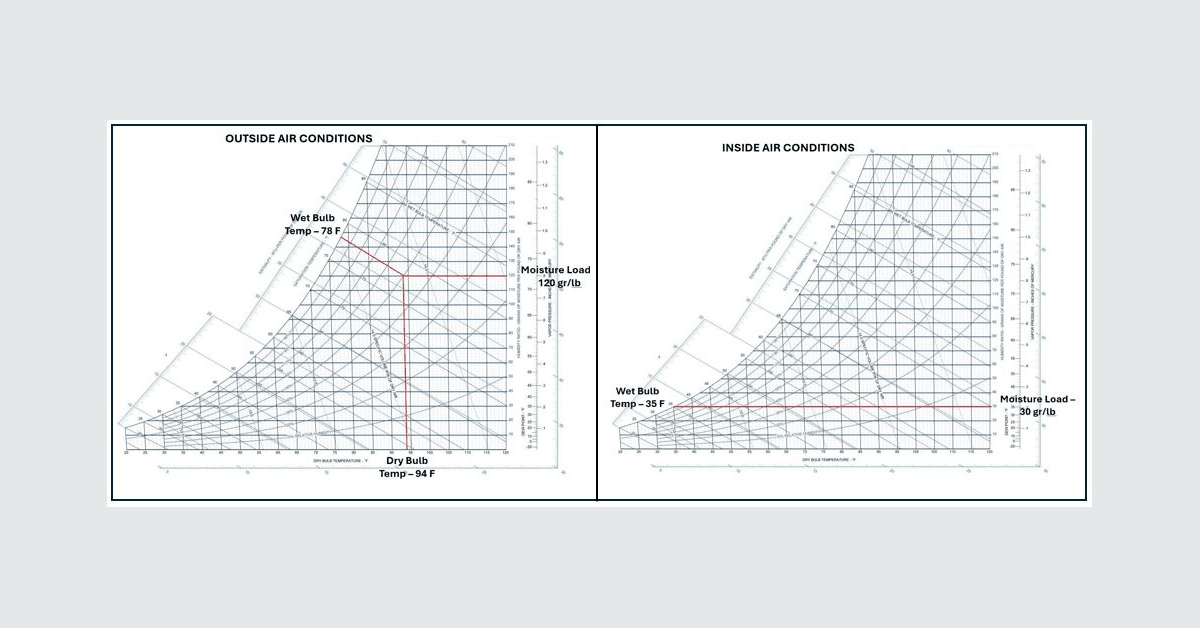
Eldridge engineers are using psychrometric charts to model and control air's thermodynamic properties, transforming the way industrial facilities manage humidity. By plotting dry-bulb, wet-bulb, and dew point temperatures, engineers can visualize when and where condensation or frost will form, then design ventilation and dehumidification systems that keep air safely below its dew point. In one recent case study, Eldridge modeled outside air at 94°F dry-bulb and 78°F wet-bulb and compared it to a 35°F cold storage environment. The resulting 90-grains-per-pound moisture differential guided precise sizing of desiccant dehumidifiers, preventing frost formation and ensuring safe, energy-efficient operations.
The psychrometric chart is not just a classroom diagram—it is becoming a blueprint for modern cold-chain management. By understanding air behavior in advance, facility managers can identify high-risk zones, reduce maintenance cycles, and protect workers before hazards occur. Settle added that by mastering humidity control, companies can move from reacting to problems to preventing them entirely, emphasizing that it is about smarter engineering—not just colder air. This approach addresses the hidden hazard of humidity, which poses significant implications for safety and efficiency in cold storage facilities nationwide.
Source Statement
This news article relied primarily on a press release disributed by Newsworthy.ai. You can read the source press release here,