IonQ's Quantum Computing Advancements Face Market Valuation Test
November 3rd, 2025 9:54 AM
By: Newsworthy Staff
IonQ's rapid quantum computing progress and $1 billion funding infusion position it as a leader in the emerging field, though its steep valuation and commercialization timeline present significant investor challenges.
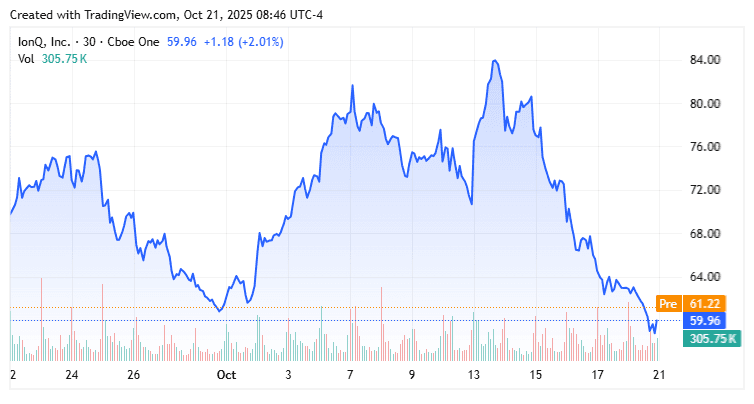
IonQ Inc. is preparing to report third-quarter results with analysts expecting revenue of approximately $27 million and full-year guidance between $82 million and $100 million. The company's quantum hardware and networking advancements come as investors assess when these technological breakthroughs will translate into sustainable profitability. The College Park, Maryland-based firm recently secured a $1 billion equity investment from Susquehanna International Group, boosting total cash reserves to roughly $1.68 billion while maintaining a debt-free balance sheet that represents one of the strongest financial positions in the quantum computing sector.
The investment deal, struck at a 25% premium, demonstrates institutional confidence in IonQ's long-term strategy and its status as a rare pure-play quantum hardware company. IonQ shares have surged more than 110% this year, reflecting market enthusiasm for both execution and financial strength. The company's enterprise value now approaches $20.7 billion, resulting in a forward EV-to-sales multiple of 227 times—a substantial valuation even for high-growth technology firms. IonQ's strategic acquisitions have significantly reshaped its technological direction, with Oxford Ionics' ion-trapping chips designed to integrate millions of qubits using existing semiconductor processes and Lightsynq's photonic interconnects aiming to link these chips into modular systems.
The company targets achieving 800 logical qubits by 2027 and 80,000 by 2030—a scale that could push quantum computing toward commercial viability. At its recent analyst day, Oxford Ionics co-founder Chris Ballance noted that approximately 95% of the hardware design overlaps with IonQ's existing systems, allowing the company to leverage mature chip fabrication infrastructure and trillions of dollars in prior semiconductor research and development to substantially reduce costs. IonQ's reach now extends beyond computation through partnerships with ID Quantique and Capella Space, positioning the company in secure communications and satellite-based quantum entanglement applications.
ID Quantique's quantum key distribution technology is already deployed by governments and financial institutions, while Capella's satellites will expand IonQ's footprint into space-based quantum networking. The company's second-quarter results showed revenue of $20.7 million, exceeding expectations by 15%, driven primarily by federal contracts with the Department of Energy and the Air Force Research Laboratory. Management anticipates continued momentum in the third quarter as it executes a backlog of projects with government and enterprise clients. Operating expenses have increased significantly, with research and development spending rising more than 230% year-over-year to $181 million in the second quarter.
IonQ reported an adjusted EBITDA loss of $36.5 million, reflecting its strategy of prioritizing capability development over cost control. Company executives have indicated they plan to maintain heavy investment throughout the decade. IonQ's collaborations with AstraZeneca, Nvidia, and Amazon Web Services have demonstrated substantial performance improvements, including a 20-fold speed increase for drug discovery simulations. Additional partnerships with Oak Ridge National Laboratory, General Dynamics, and Ansys aim to apply quantum systems to logistics and energy-grid optimization challenges.
The company's expanding software stack incorporates an in-house operating system, job scheduler, and domain-specific libraries, creating what analysts describe as a defensible competitive advantage. This structure resembles a software-as-a-service model, offering recurring revenue potential as hybrid workloads scale toward full quantum processing capabilities. At approximately $61 per share, IonQ's valuation significantly exceeds most technology peers, with traditional metrics like price-to-earnings ratios remaining irrelevant for this early-stage quantum company. The premium reflects both leadership position and market scarcity, with competitors like Rigetti Computing trading at an EV-to-sales multiple exceeding 1,500 and D-Wave Quantum around 445.
These lofty ratios highlight investor willingness to pay for exposure to a potentially transformative technological field. The primary challenge for IonQ remains commercialization timing, as delivering fault-tolerant quantum systems before 2030 would represent a major milestone, though achieving broad demand at scale depends on cost, reliability, and customer adoption beyond pilot programs. Integration risks from Oxford Ionics and Lightsynq acquisitions, combined with ongoing substantial research and development spending, could pressure margins and potentially lead to future equity dilution if revenue growth underperforms expectations. IonQ's $1.6 billion cash reserve provides an extended runway for execution, positioning the company at the intersection of cutting-edge science and market expectations—well-capitalized, technologically advanced, and priced for perfection as it transitions from research prototype to commercial platform.
Source Statement
This news article relied primarily on a press release disributed by citybiz. You can read the source press release here,