Maryland's Research Lifeline: The Critical Role of State Support in Sustaining University Science
August 14th, 2025 8:03 PM
By: Newsworthy Staff
As federal research funding faces significant cuts, Maryland's economy and its position as a leader in science and technology are at risk, highlighting the urgent need for state intervention to sustain university research and the biotech industry.
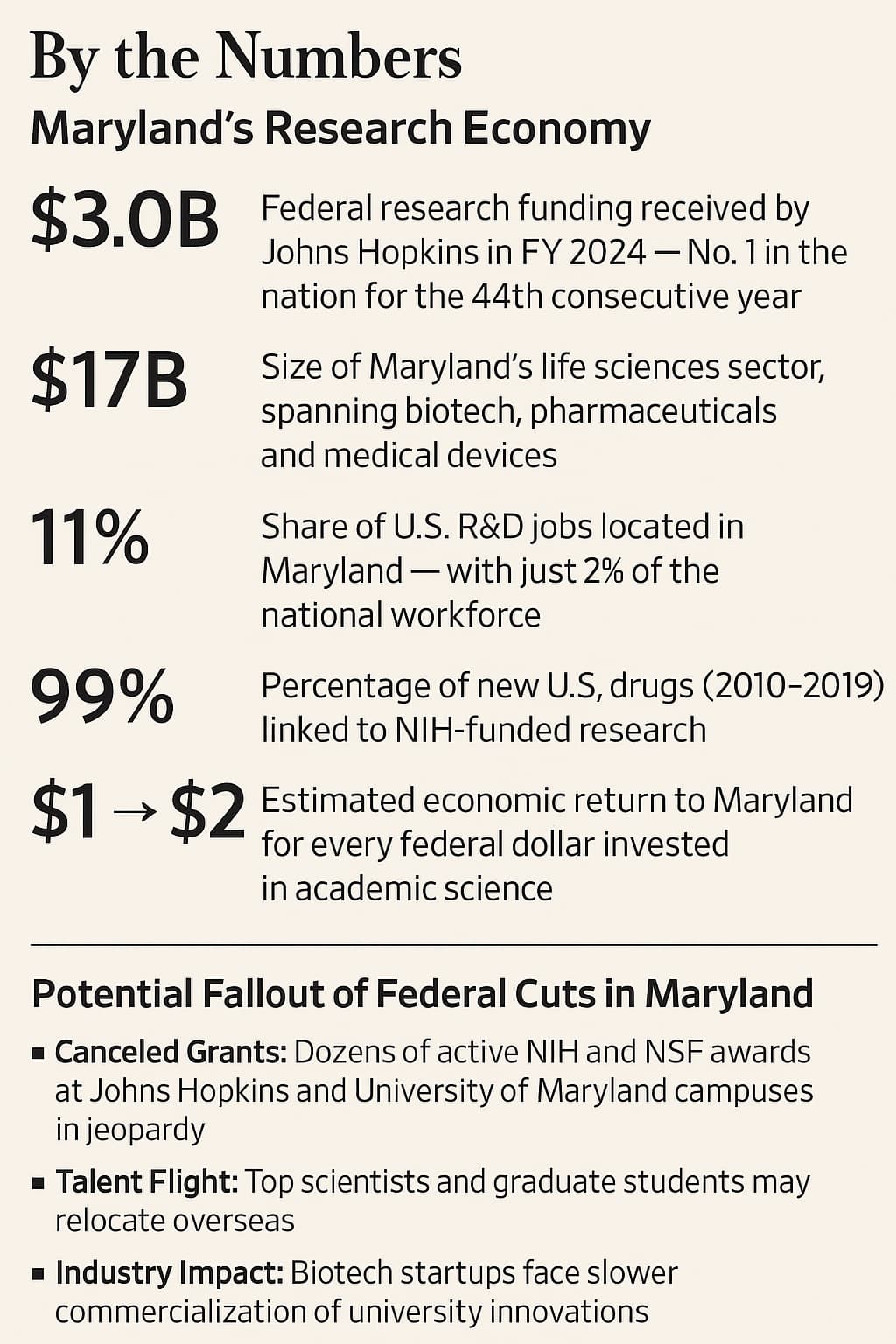
The recent sweeping cuts to federal research spending by the Trump administration, targeting over $3 billion nationwide with significant reductions in grants from the National Institutes of Health and the National Science Foundation, have placed Maryland's knowledge-based economy under unprecedented threat. Johns Hopkins University, the nation's top recipient of federal research dollars for more than four decades, is at the heart of this crisis, having secured over $3 billion in awards last year alone. These funds are pivotal for research ranging from cancer immunotherapies to artificial intelligence systems for cybersecurity, driving the state's $17 billion life sciences sector and supporting thousands of high-paying jobs.
The fragility of basic research becomes apparent when funding is interrupted; laboratories lose their lifeblood, leading to scattered graduate students, stalled projects, and idle equipment. The current federal funding rollback, coupled with proposals to increase taxes on university endowments and restrict foreign student visas, has left institutions like Johns Hopkins scrambling to address potential shortfalls in multi-year grants. This situation underscores the necessity for states to step in and fill the void left by federal cuts.
Massachusetts has already responded with a $400 million proposal to support its research institutions, setting a precedent that Maryland, with its high per-capita federal research funding, is yet to follow. Policy analysts suggest that Maryland could establish an emergency R&D fund to mitigate the loss of federal dollars, leveraging contributions from corporations, philanthropies, and venture investors. Such a fund could ensure the continuity of federally vetted projects without the state needing to make scientific judgments, thereby preserving the momentum of critical research.
The economic implications of research extend far beyond academic prestige, serving as a cornerstone for innovation, job creation, and GDP growth. From 1996 to 2020, academic research in the U.S. generated 141,000 patents and spun out 18,000 companies, contributing $1 trillion to the economy. In Maryland, the stakes are even higher, with the state's innovation ecosystem and high-skill job market heavily reliant on the research conducted at institutions like Johns Hopkins and the University of Maryland system.
Without immediate action, Maryland risks losing its scientific edge to regions like Europe and Asia, where governments are increasing research funding. The potential exodus of talented researchers and the overseas development of promising therapies and technologies present a clear and present danger to the state's economy and its standing as a leader in science and technology. The time for Maryland's leaders to act is now, to safeguard the state's research infrastructure and ensure the continued growth of its biotech economy.
Source Statement
This news article relied primarily on a press release disributed by citybiz. You can read the source press release here,