New Study Advances High-Speed Rail Safety in Icy Conditions
August 15th, 2024 7:00 AM
By: Newsworthy Staff
Researchers develop a dynamic model to assess the performance of overhead contact systems in high-speed railways under icy conditions, introducing a sensitivity coefficient to guide future design and maintenance strategies.
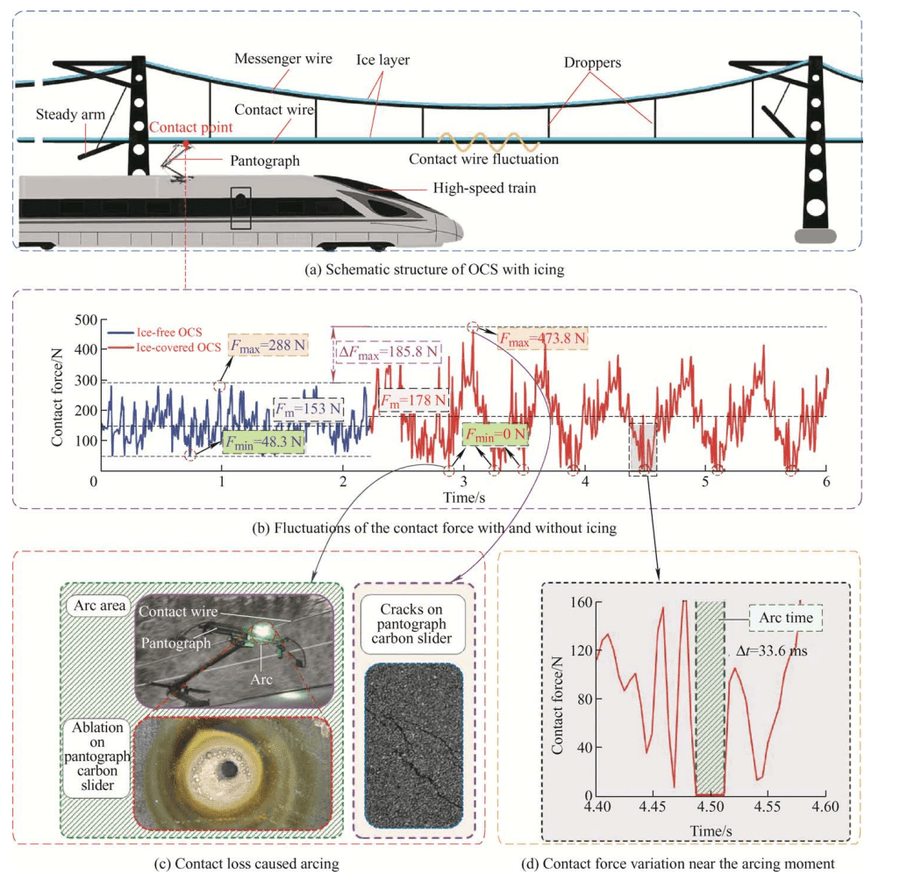
A groundbreaking study published in the Chinese Journal of Electrical Engineering on June 30, 2024, offers new insights into improving the safety and reliability of high-speed rail systems operating in icy environments. The research, conducted by experts from Southwest Jiaotong University and the National Rail Transit Electrification and Automation Engineering Technology Research Center, introduces a novel approach to evaluating the adaptability of overhead contact systems (OCS) under various icing conditions.
High-speed railways rely on the continuous and safe collection of electrical energy through the interaction between the pantograph and catenary systems. However, icy conditions can significantly disrupt this interaction, leading to safety risks and service interruptions. The study addresses these challenges by developing a dynamic model that simulates the pantograph-catenary system's performance under different ice loads.
The researchers' innovative methodology introduces a sensitivity coefficient, a quantifiable indicator of the OCS's environmental responsiveness. This new metric, combined with an analysis of five OCS prototypes, provides a robust framework for assessing the adaptability of overhead contact systems in extreme weather conditions.
Dr. Guangning Wu, an IEEE Fellow, emphasized the significance of this research, stating, "The advent of the OCS sensitivity coefficient is a quantum leap, providing us with precise standards for assessing the environmental impact of railway systems." He further noted that this work is set to redefine the resilience of overhead contact systems in extreme climates.
The study's findings have far-reaching implications for the design and maintenance of railway infrastructure, particularly in regions prone to icy conditions. By identifying OCS structures that are most capable of withstanding frost and understanding their environmental sensitivity, railway operators can implement targeted improvements. This proactive approach not only enhances the operational integrity and speed of high-speed rail systems but also paves the way for more economical infrastructure management by reducing the risk of service disruptions and their associated financial impacts.
The research team utilized critical metrics such as contact force and arcing propensity to evaluate system equilibrium and reliability. Their comprehensive approach provides valuable insights into how different ice loads affect the complex dynamics of the pantograph-catenary system, offering a foundation for future advancements in high-speed rail technology.
As climate change continues to pose challenges to transportation infrastructure worldwide, studies like this become increasingly crucial. The ability to adapt railway systems to extreme weather conditions is essential for maintaining safe, reliable, and efficient high-speed rail services. This research contributes significantly to that goal by providing a scientifically rigorous method for assessing and improving the resilience of overhead contact systems.
The study, available at https://doi.org/10.23919/CJEE.2024.000058, was supported by China State Railway Group Co., Ltd., Chengdu Guojia Electrical Engineering Co., Ltd., and the Natural Science Foundation of Sichuan Province. It represents a collaborative effort to address one of the most pressing challenges facing modern high-speed rail systems.
As the global demand for efficient and environmentally friendly transportation continues to grow, research like this plays a vital role in ensuring that high-speed rail remains a viable and reliable option, even in the face of challenging weather conditions. The insights gained from this study are expected to influence future design standards and maintenance practices for high-speed rail systems worldwide, ultimately contributing to safer, more reliable, and more resilient transportation networks.
Source Statement
This news article relied primarily on a press release disributed by 24-7 Press Release. You can read the source press release here,