Revolutionary Cancer Detection Technology to be Presented at Major Physics Conference
October 19th, 2024 7:00 AM
By: Newsworthy Staff
Italian-American scientist Dario Crosetto will showcase groundbreaking inventions for early cancer detection and particle physics at the IEEE-NSS-MIC-RTSD conference. The technology promises to detect tumors at a much earlier stage than current methods, potentially saving millions of lives and billions in healthcare costs.
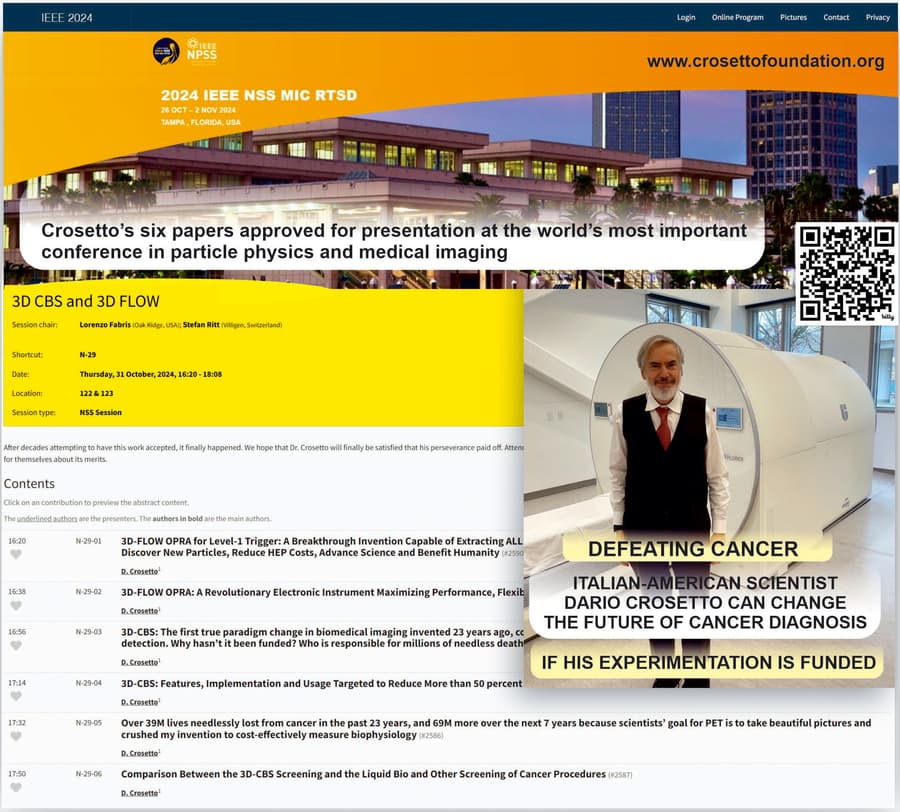
In a significant development for cancer research and particle physics, Italian-American scientist Dario Crosetto is set to present his revolutionary 3D-Flow and 3D-CBS (3-D Complete Body Screening) inventions at the world's most important conference in particle physics and medical imaging. The IEEE-NSS-MIC-RTSD conference, scheduled from October 26 to November 2, 2024, in Tampa, Florida, will host nearly 2,000 scientists from around the globe.
Crosetto's presentation, slated for October 31, will showcase technology that claims to detect tumors with as few as 100 cancer cells, a dramatic improvement over current methods like CT, MRI, and mammograms that require around 1,000,000 cells for detection. This early detection capability could be a game-changer in cancer treatment, potentially saving countless lives through timely intervention.
The implications of this technology extend beyond cancer detection. Crosetto asserts that his inventions provide powerful, cost-efficient tools for physicists to discover new particles, positioning the 3D-Flow and 3D-CBS as versatile advancements in both medical and scientific fields. The scientist claims his inventions surpass all current and past projects in terms of flexibility, performance, and cost-effectiveness.
Despite the potential impact, Crosetto's work has faced funding challenges. The scientist is using this platform to call for support from funding agencies, philanthropists, and government institutions. He argues that a fraction of the trillions spent annually on research and development could fund the construction of two 3D-CBS devices, allowing for experimental validation of his claims.
The presentation at the IEEE conference represents a significant opportunity for transparency in science. Crosetto has invited experts from CERN, various Science Academies, and the Pontifical Academy of Sciences to attend and evaluate his work. This open approach to scientific scrutiny could set a precedent for how breakthrough technologies are vetted and adopted in the future.
If Crosetto's claims prove accurate, the implications for global health and scientific research could be profound. Early cancer detection on this scale could revolutionize treatment protocols, potentially reducing cancer mortality rates and healthcare costs worldwide. Additionally, the applications in particle physics could accelerate discoveries in fundamental science, opening new avenues for understanding the universe.
However, the scientific community remains cautious. While the IEEE's approval to present at this prestigious conference lends credibility to Crosetto's work, his inventions will need to withstand rigorous peer review and experimental validation before they can be widely accepted and implemented.
As the conference approaches, the scientific community and healthcare stakeholders will be watching closely. The potential for a dual breakthrough in cancer detection and particle physics has generated significant interest, and the outcome of Crosetto's presentation could influence research priorities and funding allocations in these fields for years to come.
Source Statement
This news article relied primarily on a press release disributed by 24-7 Press Release. You can read the source press release here,