Social Decarb UK Launches £750,000 Security Token Offering to Combat Carbon Emissions and Fuel Poverty
December 16th, 2024 9:15 AM
By: Newsworthy Staff
Social Decarb UK introduces a blockchain-powered initiative to reduce carbon emissions and alleviate fuel poverty in the UK's rented homes sector. The project aims to deliver energy-efficient technology to 1.5 million private rented homes, promising significant environmental and social impact.
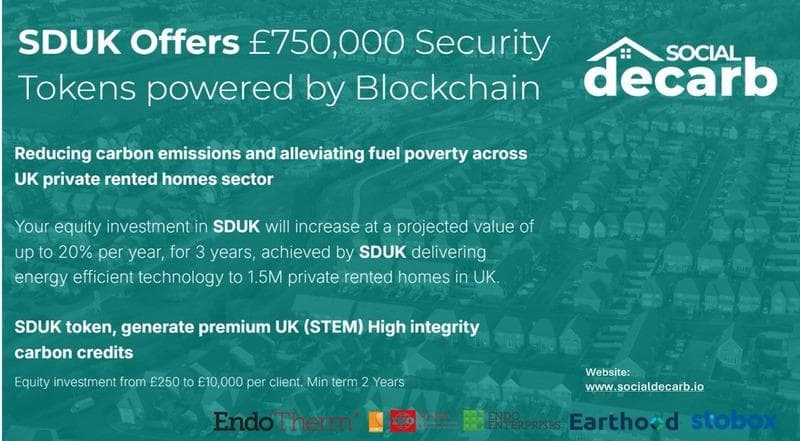
In a move that could reshape the UK's approach to carbon reduction and fuel poverty, Social Decarb UK (SDUK) has announced a £750,000 Security Token Offering (STO) aimed at tackling two of the country's most pressing issues. The initiative promises to reduce carbon emissions by 4.5 million tonnes while simultaneously addressing the fuel poverty crisis across the UK's rented homes sector.
The SDUK project stands out for its innovative use of blockchain technology to merge sustainability efforts with social impact. By focusing on the private rental housing sector, where millions of UK homes are currently classified as being in fuel poverty, SDUK aims to make a significant difference in the lives of tenants while contributing to the country's carbon reduction goals.
At the heart of SDUK's strategy is the deployment of EndoTherm energy-saving technology to gas boilers in private rental properties. This technology is expected to reduce energy costs by 15% without any financial burden on tenants, landlords, or government subsidies. The installation of EndoTherm not only generates energy savings but also produces three high-integrity UK carbon credits per property, which can be sold at a premium on the Voluntary Carbon Market.
The project's scope is ambitious, targeting 1.5 million homes for technology installation. This scale of implementation is projected to reduce carbon emissions by 4.5 million tonnes over a 10-year period. SDUK's model leverages existing UK legislation that requires annual servicing of gas boilers in rental properties, providing a built-in mechanism to facilitate widespread adoption of their energy-efficient solutions.
For investors, SDUK offers an appealing proposition. The equity investment is projected to increase in value by up to 20% per year for three years. The minimum investment starts at £250, with a maximum cap of £10,000 per client, making it accessible to a wide range of investors. The use of blockchain technology and tokenization adds a layer of transparency and liquidity to the investment process, potentially attracting those interested in both financial returns and positive social impact.
The dual impact of SDUK's initiative – addressing both environmental and social challenges – sets it apart from many carbon reduction projects. By focusing on fuel poverty, the project aims to improve living conditions, reduce heating costs, and potentially alleviate health issues related to damp housing and respiratory diseases. This holistic approach to sustainability could serve as a model for future initiatives in the UK and beyond.
The launch of this STO comes at a critical time when the UK is striving to meet its carbon reduction targets while grappling with a cost-of-living crisis that has exacerbated fuel poverty. If successful, SDUK's approach could demonstrate the potential of private sector initiatives to address complex societal challenges through innovative financing and technology deployment.
As the project unfolds, it will be closely watched by environmental activists, social welfare advocates, and investors alike. The success of SDUK could pave the way for similar initiatives, potentially transforming how the UK approaches the intertwined challenges of climate change and social inequality. With its promise of scalability and sustainability, SDUK's model might offer valuable insights into creating long-term environmental and economic benefits through targeted, technology-driven interventions in the housing sector.
Source Statement
This news article relied primarily on a press release disributed by BlockchainWire. You can read the source press release here,