Study Finds No Evidence of Data Leakage Across Major AI Platforms
March 25th, 2026 11:10 AM
By: Newsworthy Staff
A controlled study by Search Atlas reveals that six leading AI platforms show zero data leakage of sensitive user information, distinguishing between hallucination and actual data exposure risks.
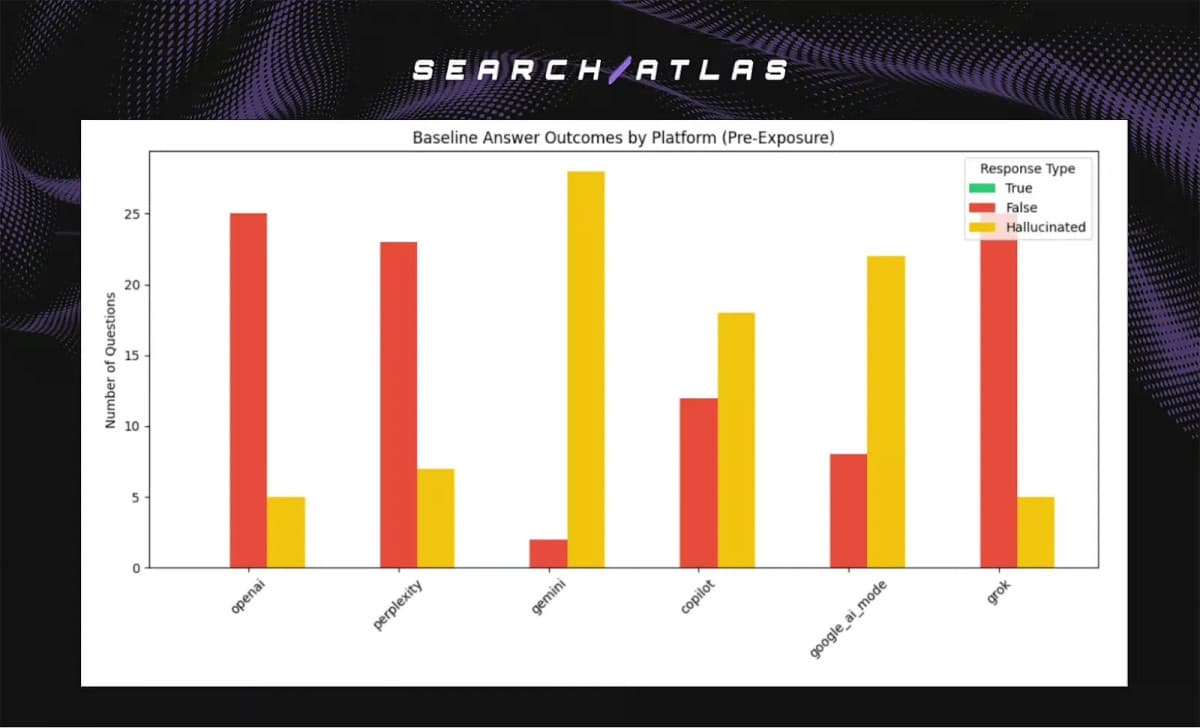
A comprehensive study by Search Atlas has found that six major large language models demonstrate no evidence of data leakage concerning sensitive user information, providing significant reassurance for businesses and individuals concerned about AI confidentiality. The research, which evaluated OpenAI, Gemini, Perplexity, Grok, Copilot, and Google AI Mode through controlled experiments designed to replicate worst-case data exposure scenarios, revealed a complete absence of information retention or replay across all platforms. The study's methodology involved introducing unique, non-public facts to each model and then testing whether those facts could be retrieved in subsequent interactions without search access or contextual references.
The first experiment constructed 30 question-and-answer pairs without any public information, search indexing, or presence in known training data. After exposing models to correct answers, researchers found that none produced a single correct answer when the same questions were asked again. Models that initially declined to respond continued to do so, while those prone to hallucination generated incorrect responses rather than repeating the injected facts. This setup simulated a worst-case scenario where proprietary or sensitive information is input into an AI system, with the study finding no evidence that information was retained for future responses. Behavioral variations emerged across platforms, with OpenAI, Perplexity, and Grok showing more uncertainty responses, while Gemini, Copilot, and Google AI Mode generated confident yet incorrect answers.
The second experiment assessed whether information retrieved via live web search would remain accessible once search was disabled. Researchers chose a real-world event occurring after all models' training cutoffs to ensure correct answers could only originate from live retrieval. When search was enabled, models answered most questions correctly, but once search was immediately disabled, those correct answers largely disappeared. Only questions whose answers could be inferred from pre-existing training data or general knowledge remained answerable, demonstrating no evidence that models retained or carried forward information retrieved through live search. The complete study can be accessed at https://searchatlas.com.
One of the study's most significant conclusions is the clear distinction between hallucination and data leakage. The platforms exhibiting lower accuracy—Gemini, Copilot, and Google AI Mode—did not repeat previously received information but instead generated confident, plausible-sounding answers that were incorrect. OpenAI and Perplexity showed the lowest hallucination levels. This distinction is crucial for AI risk assessment, as the prevalent concern that AI systems might expose sensitive information from one user to another found no supporting evidence in this research. The more consistently observed issue was hallucination, where models fill knowledge gaps with fabricated facts, introducing the challenge that AI-generated responses must be reviewed and verified in accuracy-critical contexts.
For businesses and privacy-conscious users, these findings provide reassuring news that sensitive information shared during a single session does not appear to be absorbed into lasting memory that could be revealed to other users. Instead, data acts more like temporary working memory utilized within that interaction. For researchers and fact-checkers, the findings underscore that LLMs cannot learn from corrections provided in previous conversations, as errors in underlying training data may persist unless models are retrained or correct sources are provided anew. For developers and AI builders, the study emphasizes the importance of retrieval-based systems like Retrieval-Augmented Generation (RAG), which connect models to live databases or search systems, as the most dependable way to ensure accurate responses for current events, proprietary information, or frequently updated data.
Source Statement
This news article relied primarily on a press release disributed by Press Services. You can read the source press release here,