Transfer Learning Revolutionizes Streamflow Forecasting in Data-Scarce Regions
August 23rd, 2024 7:00 AM
By: Newsworthy Staff
A groundbreaking study introduces a transfer learning framework that significantly improves daily streamflow predictions in transboundary basins with limited data, potentially transforming water resource management and climate change mitigation efforts.
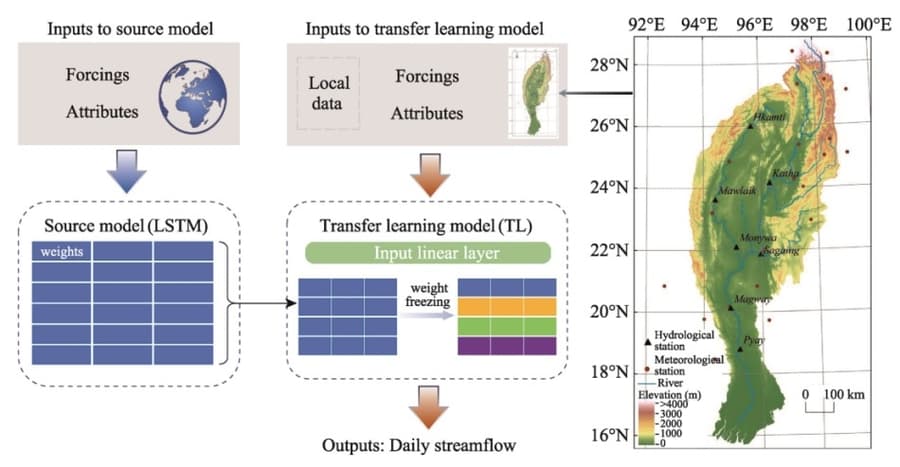
A collaborative research team from Yunnan University and Pennsylvania State University has developed a novel transfer learning framework that promises to revolutionize streamflow forecasting in regions with limited hydrological data. The study, published in the Journal of Geographical Sciences on May 10, 2024, demonstrates how this innovative approach can enhance water resource management and support climate change adaptation strategies in transboundary basins.
Streamflow modeling plays a crucial role in securing water supplies and assessing the impacts of climate change. However, the uneven global distribution of gauges and the scarcity of data in large transboundary basins have long posed challenges to accurate predictions. The new transfer learning model addresses these limitations by significantly improving the precision of daily streamflow forecasts in data-scarce regions.
The research team tested their framework in the Dulong-Irrawaddy River Basin, an area that has been historically understudied due to data constraints. The results were impressive, with the model outperforming conventional process-based approaches and demonstrating remarkable adaptability to the basin's unique hydrological characteristics.
Dr. Ma Kai, a principal investigator and co-author of the study, emphasized the significance of this research, stating, "This research not only meets the urgent demand for reliable streamflow predictions in regions with limited data but also paves the way for a more profound comprehension of the complex dynamics governing our hydrological systems."
One of the key strengths of the new model is its ability to capture intricate, nonlinear interactions among variables, as revealed by sensitivity analysis. Additionally, the integrated gradients analysis highlighted the model's capacity to delineate diverse flow patterns and spatial variations, offering deeper insights into the hydrological processes within large-scale catchments.
The implications of this study extend far beyond academic circles. By providing a robust tool for water resource stewardship in transboundary basins, the transfer learning approach represents a paradigm shift in water resource forecasting and management. This breakthrough is particularly timely given the increasing challenges posed by climate change and water scarcity in vulnerable regions around the world.
The research, funded by various Chinese national programs including the National Key Research and Development Program and the National Natural Science Foundation of China, underscores the importance of international collaboration in addressing global water management challenges.
As climate change continues to alter hydrological patterns worldwide, the need for accurate streamflow predictions becomes increasingly critical. This new transfer learning framework offers a promising solution, potentially enabling more effective water resource management strategies in regions where data has been historically limited.
The study's findings, published in the Journal of Geographical Sciences, are expected to catalyze further research and applications in the field of hydrology. As water security becomes an ever more pressing global concern, innovations like this transfer learning model may prove instrumental in safeguarding water resources for future generations.
For those interested in delving deeper into the technical aspects of this groundbreaking research, the full study can be accessed at the DOI: 10.1007/s11442-024-2235-x. This publication marks a significant step forward in the field of hydrological modeling and sets the stage for improved water management practices in some of the world's most challenging environments.
Source Statement
This news article relied primarily on a press release disributed by 24-7 Press Release. You can read the source press release here,