United States of KAILASA Hosts Session on Indigenous Knowledge at UN General Assembly Science Summit
September 14th, 2024 7:00 AM
By: Newsworthy Staff
The United States of KAILASA hosted a virtual session at the 79th UN General Assembly Science Summit, focusing on integrating indigenous Hindu knowledge with modern science. The event highlighted ancient practices in medicine, environmental conservation, cosmology, and power manifestation, emphasizing their relevance to sustainable development and scientific advancement.
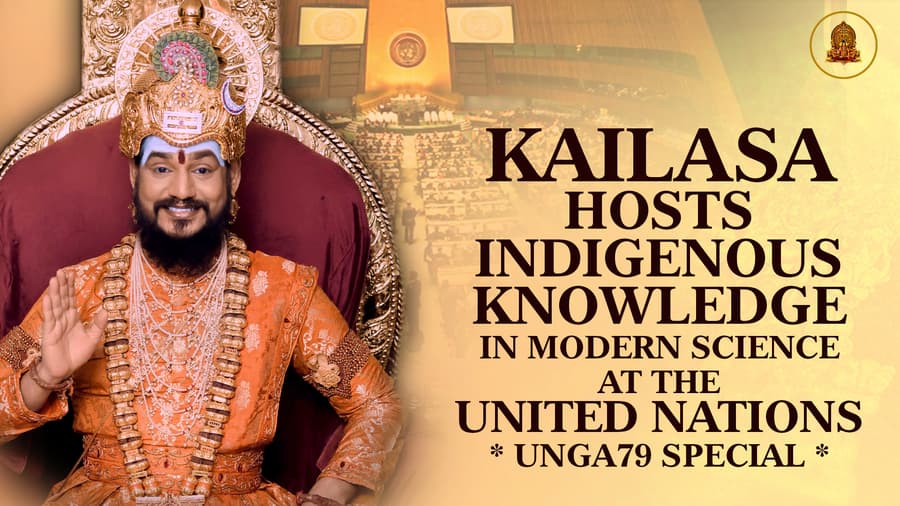
In a significant development at the 79th UN General Assembly Science Summit, the United States of KAILASA (USK) hosted a two-hour virtual session exploring the integration of indigenous knowledge into modern science. The event, which took place on September 14, 2024, drew thousands of virtual attendees and livestream viewers, showcasing the potential of ancient Hindu sciences to complement and enhance contemporary scientific practices.
The session, held under the auspices of The Supreme Pontiff of Hinduism (SPH) Bhagavan Nithyananda Paramashivam, covered a wide range of topics including indigenous Hindu medicine, environmental conservation, cosmology, astronomy, and power manifestation. This comprehensive approach aimed to demonstrate how traditional Hindu wisdom can contribute to addressing global challenges and achieving the UN Sustainable Development Goals (SDGs).
One of the key focuses of the session was on indigenous Hindu medicine, particularly Ayurveda and Siddha, which have roots dating back over 11,000 years. These holistic healing systems, emphasizing comprehensive well-being and natural remedies, were presented as valuable complements to modern medical practices. The session highlighted how these ancient approaches could offer sustainable health solutions and insights into preventive care.
Environmental conservation was another crucial topic discussed during the event. The session explored Hindu principles of reverence for nature and environmental stewardship, presenting them as potential solutions to current ecological challenges. KAILASA's initiatives, such as the Clean Air Initiative and the Go Zero Waste program, were showcased as practical applications of these principles in promoting sustainable development.
In the realm of cosmology and astronomy, the session delved into the Surya Siddhanta, an ancient Indian text on astronomy and mathematics. The presentation offered new perspectives on understanding the universe, including a reinterpretation of Einstein's famous equation E=mc². This segment highlighted how ancient Hindu cosmological concepts could potentially offer new insights into modern physics and astronomy.
The final segment of the session focused on power manifestation, a concept rooted in Hindu yogic traditions. This part of the presentation explored phenomena such as Kundalini awakening, Third Eye AwakeningSM, and advanced yogic practices like levitation and teleportation. While these concepts may seem esoteric, the session aimed to present them as areas worthy of scientific investigation and potential sources of new understanding in physics and human capabilities.
The significance of this session extends beyond its immediate content. By presenting these ancient practices and knowledge systems in the context of a UN General Assembly Science Summit, the event sought to bridge the gap between traditional wisdom and modern scientific thought. It suggests a potential paradigm shift in how we approach global challenges, proposing that solutions might be found by integrating diverse knowledge systems.
Furthermore, the session's focus on sustainable development and holistic well-being aligns closely with the UN's Sustainable Development Goals. By showcasing how ancient Hindu practices can contribute to areas such as health, environmental conservation, and scientific understanding, the event presented a unique perspective on achieving these global objectives.
As the world grapples with complex issues like climate change, public health crises, and the need for sustainable development, this session at the UN General Assembly Science Summit opens up new avenues for discussion and research. It challenges the scientific community to consider alternative knowledge systems and explore how they might complement or enhance current scientific understanding.
The event also raises important questions about the role of indigenous knowledge in modern science and global policy-making. As we move towards a more interconnected world, the integration of diverse knowledge systems could lead to more holistic and effective solutions to global challenges.
In conclusion, the United States of KAILASA's session at the UN General Assembly Science Summit represents a significant step towards recognizing the potential contributions of indigenous knowledge to modern science and global development. It underscores the importance of diverse perspectives in addressing world issues and suggests that ancient wisdom, when combined with modern scientific methods, could offer innovative solutions to some of our most pressing global challenges.
Source Statement
This news article relied primarily on a press release disributed by 24-7 Press Release. You can read the source press release here,