AI Training vs. AI Grounding: Why Content Marketers Should Know the Difference
There's a common misconception about AI and content: If an AI system crawls or sees your content, it is learning from it. Not necessarily. Understanding the difference between AI training and AI grounding helps explain why publishing useful, authoritative content may be becoming more important in the age of AI.

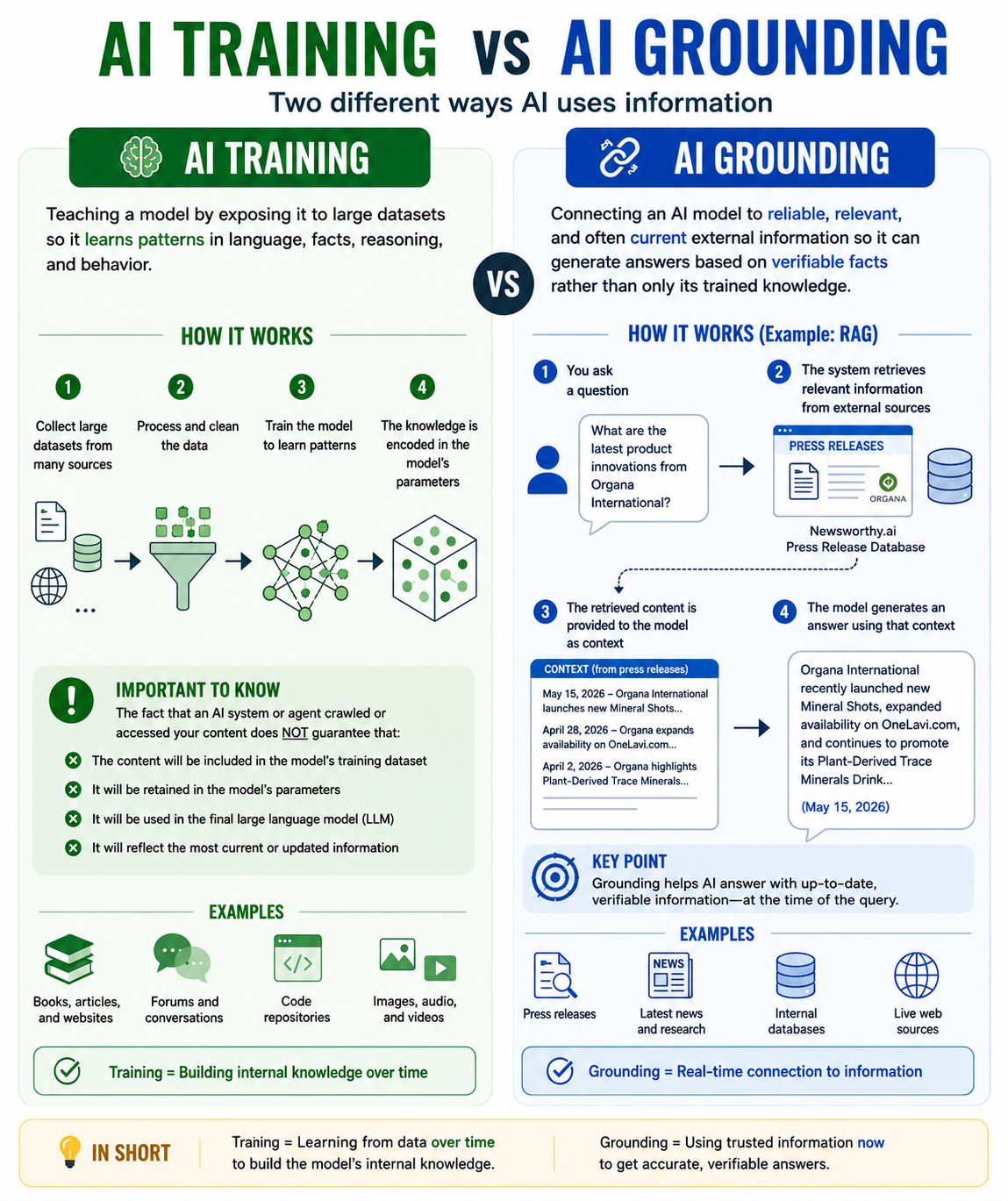
AI training happens when a model is built. Large amounts of data are used to teach the model patterns in language, knowledge, reasoning, and behavior.
But training has an important limitation: it is necessarily historical.
A model's training reflects information available during its training process. It does not automatically know what happened afterward, and it may not know information that wasn't included in its initial training.
And just because an AI system crawls or accesses your content does not mean that your content will become part of the model's training data, be retained in the model, or influence future "AI" answers.
That's where AI grounding becomes important.
Grounding connects an AI system to external data that can help it answer a question using relevant, CURRENT information.
One common approach is what' called Retrieval-Augmented Generation (RAG). Rather than relying entirely on what the model learned during training (historical with a finite cut-off date) RAG retrieves relevant current information (outside of it's model) from external sources and then provides that information to the model as context before it answers.
Think of the difference this way:
Training helps build the brain.
Grounding gives the brain something current to read before answering.
And that distinction has important implications for content strategy.
As an example: historically, marketers have evaluated content primarily through human exposure and engagement:
How many people saw it?
How many clicked?
How many read it?
How many engaged w/ it?
Those metrics still matter but there is now another audience for well-structured public information: AI retrieval systems.
A useful piece of content can establish facts, explain expertise, define products or services, reinforce associations with particular subjects, and provide current information that can potentially be retrieved when an AI system needs context for an answer.
That value isn't necessarily captured by impressions, clicks, or page views.
This suggests an additional question for anyone creating content:
Are we publishing information that is clear, authoritative, current, and useful enough to be retrieved when someone asks a relevant question?
Because an AI system can't retrieve information that isn't available to retrieve.
And simply publishing more content isn't the answer. Content should be clear, well-structured, factually specific, and consistent about the people, companies, products, and topics it describes. The easier it is for retrieval systems to understand what the content is about and connect it to the right entities and questions, the more useful that content can become.
In the search era, creating content was partly about being found.
In the AI era, it is increasingly about being found, understood, and retrieved.
That's a very different way to think about the value of content.
We’re seeing this machine audience firsthand at Newsworthy.ai.
We now track both recognized AI training crawlers and search engine crawlers accessing press releases across our platform. The numbers are displayed live on the top of Newsworthy.ai, showing activity over the previous 24 hours.
An AI crawl doesn’t mean a release will become part of a model’s training data, just as a search crawl doesn’t guarantee how or where content will appear in search. But both are signals that machines are actively discovering and accessing the content.
And that reinforces the larger point: content today increasingly has two audiences: people and machines.
If you want your information to be found, understood, retrieved, and potentially cited by AI, it first has to exist somewhere those systems can discover it.