MarketWatch Just Killed Press Releases. Good.
For years, companies were told that getting their press release on MarketWatch meant something. It didn’t. It meant you paid a newswire, and your content got dumped into a high-authority domain alongside thousands of other releases nobody read. Now it’s over.

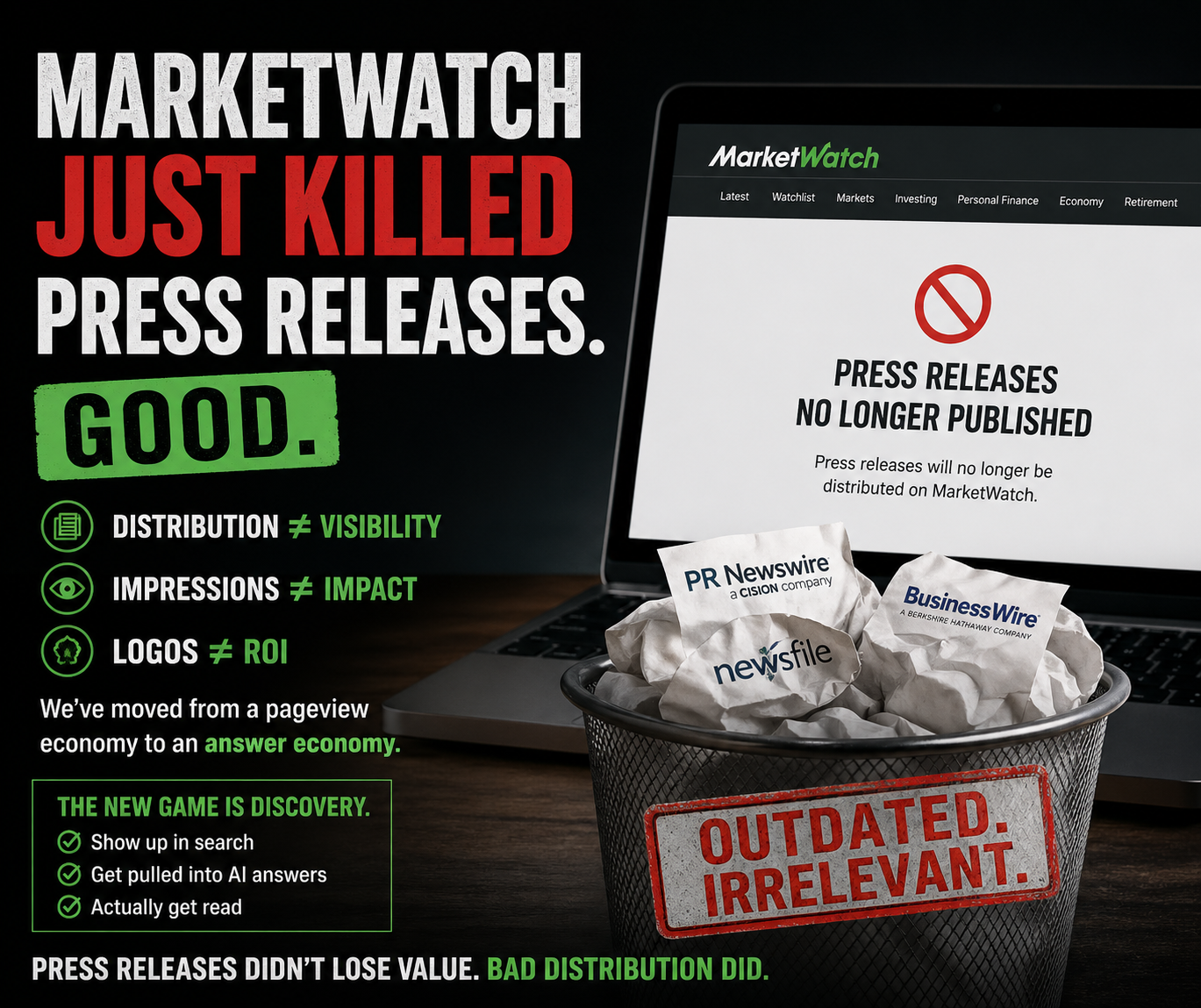
Dow Jones & Company, which owns MarketWatch, has officially decided to remove press releases from the platform entirely.
Gone.
And honestly, it was inevitable.
The Press Release Illusion
Let’s be clear about what just died.
Not press releases but the illusion of value.
For decades, the model looked like this:
- Pay a wire
- Get distribution
- Show clients a list of logos
- Call it success
But those placements were never about readership, engagement, or impact. They were about optics. MarketWatch wasn’t curating your story. It was hosting it. There’s a difference.
Why MarketWatch Likely Pulled the Plug
In our opinion (we don't know for sure because we have no relationship nor contact with MarketWatch), this wasn’t some random product decision. It’s a signal.
Three things changed.
1. They Want to Own the Content
Dow Jones also owns The Wall Street Journal.
Letting third-party press releases flood MarketWatch made less and less sense.
It diluted their brand.
It competed with their own journalism.
It handed over valuable search real estate to paid content.
So, they did the obvious thing.
They took control back.
2. AI Still Needs Press Releases. Just Not the Old Kind
This is the part most people are getting wrong.
We’re no longer in a pageview economy. We’re in an answer economy.
AI systems absolutely use press releases. In fact, they’re one of the most important inputs.
Why?
Because press releases are:
- Direct from the source
- Time-stamped
- Entity-rich
- Full of quotable, attributable information
That’s exactly the kind of content AI systems are built to ingest.
But here’s the problem.
Not all press releases are created equal.
When they’re:
- Poorly structured
- Overly promotional
- Lacking clear entities and context
- Published in bulk with no consistency
They become weak signals.
That’s where platforms like MarketWatch ran into trouble. It wasn’t that press releases lost value. It’s that unstructured, low-quality distribution at scale doesn’t work in an AI-driven environment.
So instead of hosting thousands of inconsistent releases, it becomes more valuable for Dow Jones & Company to extract the signal, normalize it, and publish controlled summaries.
Same underlying information.
But cleaner, more usable, and aligned with how AI systems actually process content.
That’s exactly the gap Newsworthy.ai was built to solve.
3. Let’s Be Honest. There Was a Lot of Junk
Everyone in the industry knows it.
Thousands of releases that weren’t really news.
Keyword-stuffed announcements.
Vague partnerships.
Recycled marketing copy.
Even the good releases got buried in the noise.
From MarketWatch’s perspective, the easiest way to fix the problem was simple.
Remove the entire category.
What This Actually Means
If you’re still measuring PR success by “where did it get published,” this should be a wake-up call. Why? Because one of the most recognizable placements just disappeared overnight.
And nothing broke.
The Old Model Is Cracking
The traditional playbook.
- Distribution equals value.
- Impressions equal success.
- Logos equal proof.
That model is fading fast. Not because press releases don’t matter.
But because where they live matters less than how they’re discovered.
Discovery Is the New Distribution
Search engines and AI platforms are now the gatekeepers. Not editors. Not newswire feeds. Which means if your content isn’t structured for discovery, it won’t be found.
If it isn’t clear, it won’t be used.
If it isn’t trusted, it won’t be cited.
That’s the game now.
The Irony
Some companies will panic about losing MarketWatch.
They shouldn’t.
Because most of them weren’t getting value from it in the first place. What they were getting was a familiar logo, a line in a report, and a false sense of reach.
That’s gone now.
Good.
Where This Is Headed
This is part of a larger shift.
From mass distribution, passive hosting, and vanity metrics.
To structured content, active discovery, and measurable engagement.
Press releases aren’t disappearing. They’re evolving. The ones that win going forward won’t be the ones that get published.
They’ll be the ones that show up in search, get pulled into AI responses, and actually get read.
Why We Built Newsworthy.ai This Way
This shift didn’t just happen overnight. It’s been coming for years. That’s exactly why we built Newsworthy.ai differently from the start.
Not as a traditional “wire,” but as a platform designed for how news is discovered today.
Instead of optimizing for placements, we focused on:
- Structured, AI-readable content
- Search visibility and indexing
- Entity clarity and trust signals
- Content that can be retrieved, not just hosted
Because the reality is simple.
If your press release isn’t being found in search or used by AI systems, it doesn’t matter where it was “published.”
That’s the gap most legacy press release newswires never addressed.
You Don’t Need More Distribution. You Need Better Discovery.
Losing MarketWatch feels like a big deal.
But it only matters if your strategy depended on it.
If your goal is real visibility, real engagement, and real discoverability, nothing actually changed.
In fact, this shift makes it easier to see what works and what doesn’t.
If you’re still chasing placements, you’re playing a shrinking game.
If you’re optimizing for discovery, you’re playing the next one.
That’s where everything is headed.
Final Thought
MarketWatch didn’t kill press releases.
It exposed them.
And if your strategy depended on a logo instead of actual visibility, it was already broken.
If you’re ready to rethink how your news gets found, not just published, it might be time to try a different approach.