The Press Release Isn't Dead. It Just Became One of the Most Important Documents on the Web.
I've been in the press release business since 1997. I built PRWeb because I believed press releases should be searchable, public, and directly accessible to anyone. Since then I've watched the industry shift from fax machines to email blasts, from newswires to search engines, from SEO to social media. Every one of those shifts felt enormous at the time.

Founder, Newsworthy.ai
None of them compare to what's happening right now.
And here's the strange part: in the middle of the biggest change I've seen in three decades, half the marketing world is busy declaring the press release dead. They could not be more wrong.
The press release isn't dead. Artificial intelligence may have just made it one of the most important documents you can publish.
The Thing That Actually Changed
Search engines no longer just rank blue links. Google's AI Overviews summarize answers before you ever scroll. ChatGPT, Perplexity, Claude, Copilot, and Gemini don't return a list of ten websites. They return an answer: a synthesized response drawn from sources the user may never click.
People now ask these systems questions the way they used to ask Google.
That one behavioral shift changes everything for marketers, communicators, and PR professionals. Because if the system hands the user a finished answer, the entire game becomes: Is your information inside that answer or not?
The Press Release as a Retrieval Asset
What most organizations don't realize is that a press release is no longer just a communications tool. It's a retrieval asset.
Stop and think about what a press release actually is.
It's public. It's timestamped. It's structured. It names specific entities like companies, people, products, and locations. It makes declarative statements. It lives on the open web. It gets archived, indexed, and often persists for years.
That's not a relic of old PR. That's a description of exactly the kind of document AI retrieval systems are designed to find, evaluate, and reuse.
The format PR professionals have used for more than a century turns out to be remarkably compatible with how modern AI systems discover and ground information. We just have to use it correctly.
Compare that to a blog post.
When someone reads, "Acme Corp announced today that it has partnered with Beta Inc. to expand operations in the Southeast," their brain often registers it as a factual announcement. The same information in a blog post can feel more promotional.
The press release format does work that no amount of clever copywriting can fully replicate. That psychological weight can influence how both people and machines evaluate information.
The Opportunity Hiding Inside News
There's another advantage most marketers miss entirely.
News, by definition, is new.
The partnership you just announced. The product you just launched. The research you just released. None of it existed before you published it.
You're creating net-new information.
That matters because AI systems don't just look for authority. They often favor information that is authoritative, discoverable, and current.
Imagine your company announces a new partnership today. Six months from now, someone asks an AI system about companies operating in that space. If your announcement was published properly, structured clearly, and remained accessible on the web, it has a chance to become part of the answer.
Evergreen blog posts compete with thousands of similar pages covering the same topic. A well-structured press release about something that genuinely just happened occupies a space that didn't exist before publication.
Run This Today
Pull up your most recent press release and check it against the four properties that make the format AI-compatible:
- Public: Is it on the open web at a stable URL, not locked behind a PDF or inaccessible system?
- Timestamped: Is the publication date clear and machine-readable?
- Structured: Does it include a headline, dateline, declarative paragraphs, and a clear About section?
- Entity-rich and declarative: Does it name your company, products, people, and category in plain, factual language?
If your release passes all four, you're already holding a retrieval asset.
If it doesn't, you've just found your first improvement.
-----
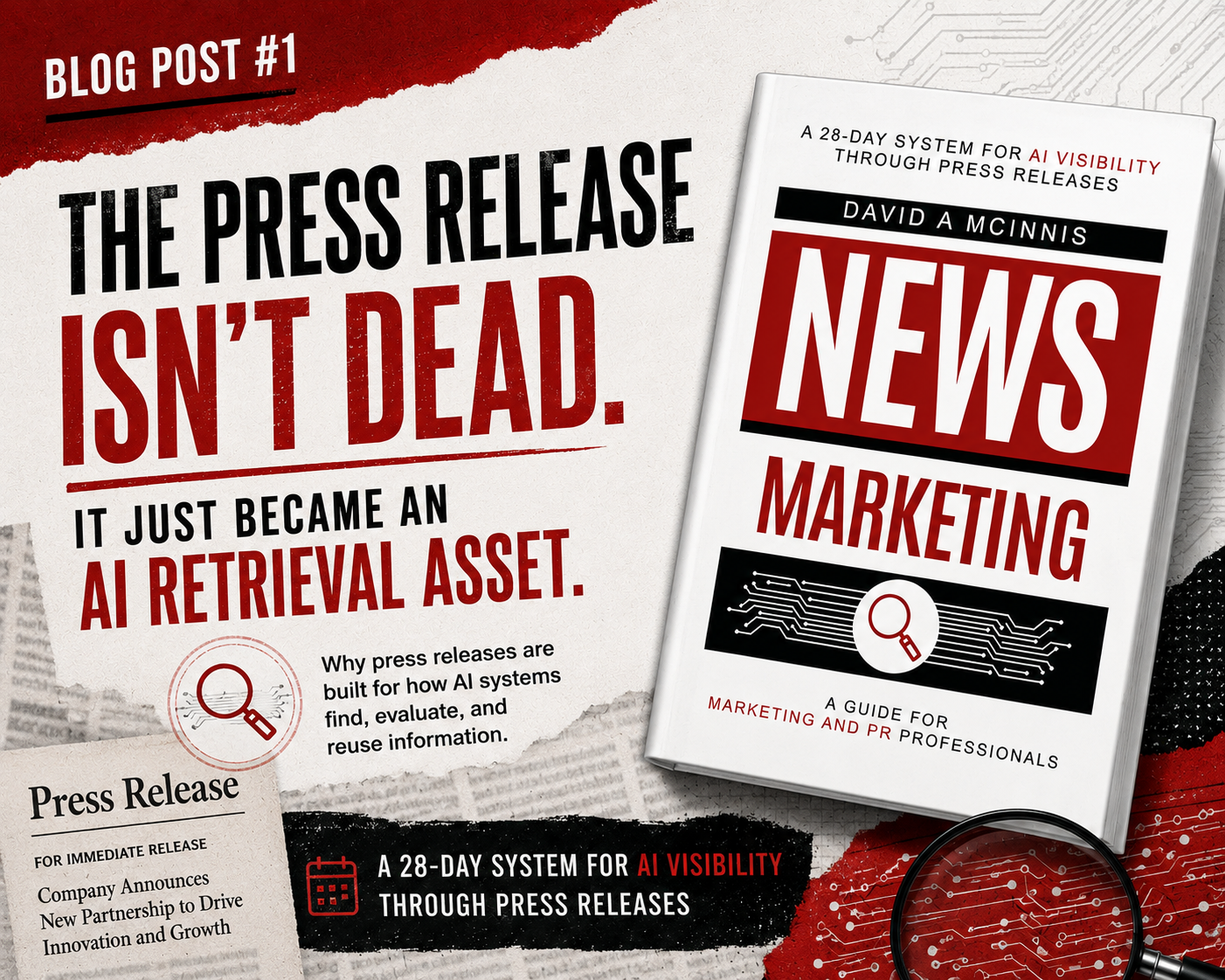
This article is adapted from News Marketing: The 28-Day System for AI Visibility Through Press Releases by David A. McInnis, founder of PRWeb and co-founder of Newsworthy.ai.
Readers can download a free digital copy of the book here or purchase the paperback and Kindle editions on Amazon.
This is the first post in a multi-part series exploring how press releases, news content, and AI retrieval systems are reshaping online visibility. Next up: why "distribution", the metric our industry has worshipped for decades, may be the wrong thing to measure in the age of AI, and what matters instead.