The $600 Mistake That Changed PR Forever
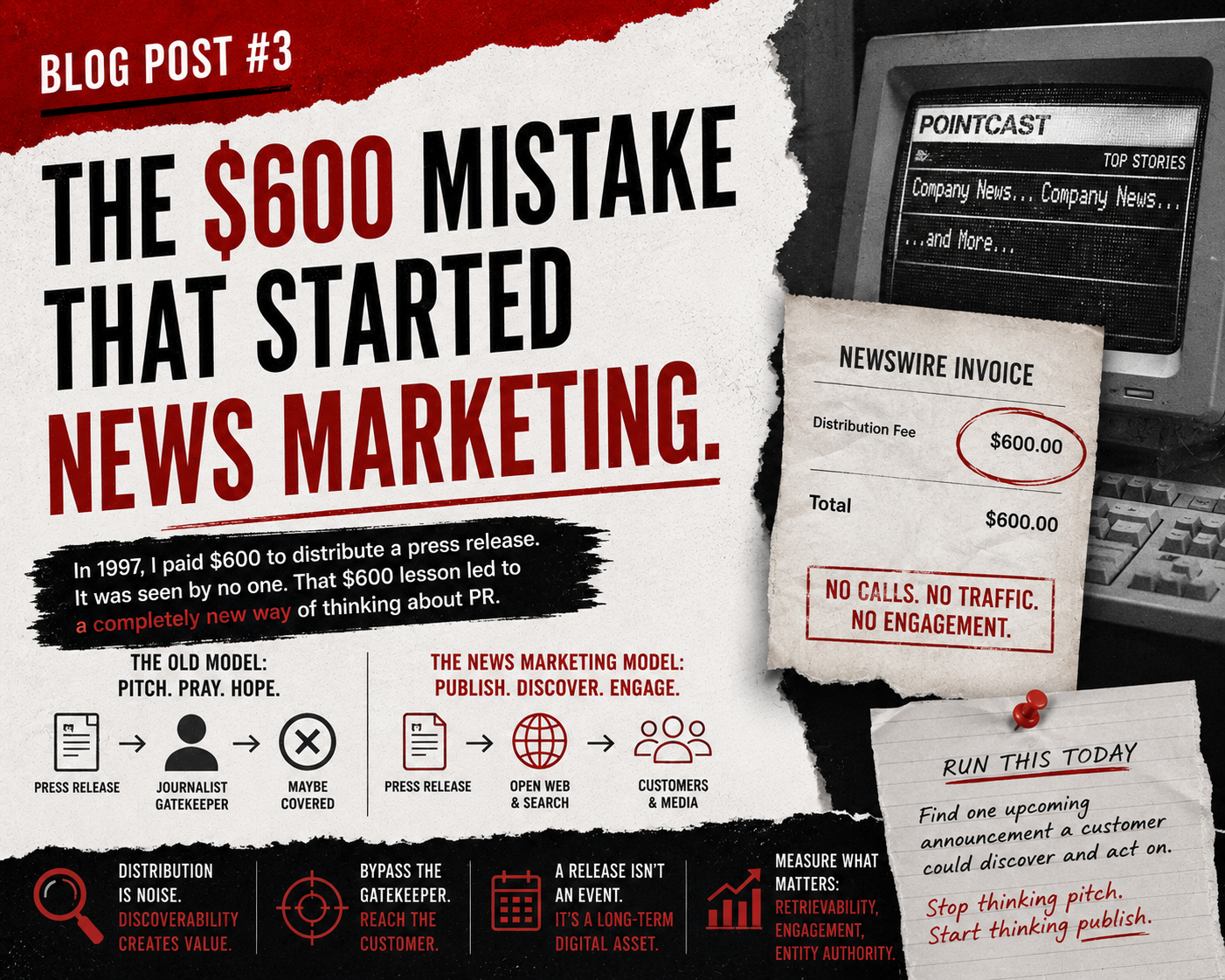
The $600 Lesson. In 1997, I had a $600 epiphany. I was running a small business, wanted press coverage, and did what everyone said to do: I wrote a press release and paid a traditional newswire $600 to distribute it. The release went out. I watched it scroll across PointCast, the hot push-media platform of the moment. Then it disappeared. Just a fleeting line of text on a screen that almost nobody was watching.

Founder, Newsworthy.ai
I sat there and asked myself a simple question:
What does a newswire actually do?
The answer changed my career.
A newswire distributes.
But distribution without discoverability is just noise.
My release had reached thousands of endpoints and been discovered by almost no one.
The Insight
Around the same time, I was watching pharmaceutical companies change the way they marketed new drugs.
Instead of relying entirely on physicians, they began telling consumers to "ask your doctor" about specific medications.
They had found a way to bypass the traditional gatekeeper.
That made me wonder:
Could press releases do the same thing?
Could they bypass the journalist and reach customers directly?
The answer turned out to be search.
The web was exploding. Search engines were indexing everything. People were finding information on their own terms. If press releases lived on the open web instead of inside proprietary wire systems, customers could discover them without waiting for a journalist to write a story.
That insight eventually led me to create PRWeb.
Bypassing the Pitch
In the late 1990s, PR revolved around one activity:
The Pitch.
The press release wasn't really the product. The product was convincing a journalist to write about it.
That worked if you were Coca-Cola or Microsoft.
It didn't work very well if you were a regional software company or a startup with twelve employees.
Instead of trying to improve the pitch, I wanted to eliminate its importance.
We published press releases on the open web, and we optimized them for search.
We made them available to anyone, not just journalists with expensive wire terminals.
We treated every release as a searchable, direct-to-customer asset years before "content marketing" became a buzzword.
It worked.
Customers found the releases. Bloggers found them. Analysts found them.
Journalists found them too but on their own terms, through search rather than a cold pitch.
That became the foundation of what I now call News Marketing.
The Framework
News Marketing is the strategic use of news-format content—primarily press releases—as discoverable, multi-format assets designed to reach customers, AI systems, and media wherever they consume information.
It follows three principles:
- Your audience isn't just journalists. It's customers and the AI systems they use to discover information.
- Success isn't measured by impressions. It's measured by retrievability, engagement, and entity authority.
- A press release isn't an event. It's a long-term digital asset.
The technology has evolved from search engines to AI.
The principle hasn't changed.
When the gatekeeper model doesn't serve you, go direct.
Run This Today
Look at your next company announcement—a new capability, customer win, partnership, product launch, or research report.
Now ask yourself:
Could a customer discover this directly without a journalist in the middle?
If the answer is yes, you've identified your next News Marketing asset.
Stop thinking about it as something to pitch. Start thinking about it as something to publish where your customers—and increasingly AI systems—are already looking.
This article is adapted from News Marketing: The 28-Day System for AI Visibility Through Press Releases by David A. McInnis.
Next up: why one announcement shouldn't stop with a press release—and how turning a single story into multiple content assets dramatically increases AI visibility.