Why Press Releases Matter More in the Age of AI
For years, companies have treated press releases primarily as a way to get media coverage. That is becoming an outdated way to think about them. AI is changing how people discover businesses, products, expertise, and information. Instead of searching Google and clicking through a list of websites, people increasingly ask ChatGPT, Gemini, Perplexity, Google AI Overviews, and other AI-powered systems a question and receive a synthesized answer. That creates a new challenge for every company. When someone asks a question related to your business, can AI find you? Understanding why press releases can help starts with understanding something surprisingly simple about how AI finds current information.

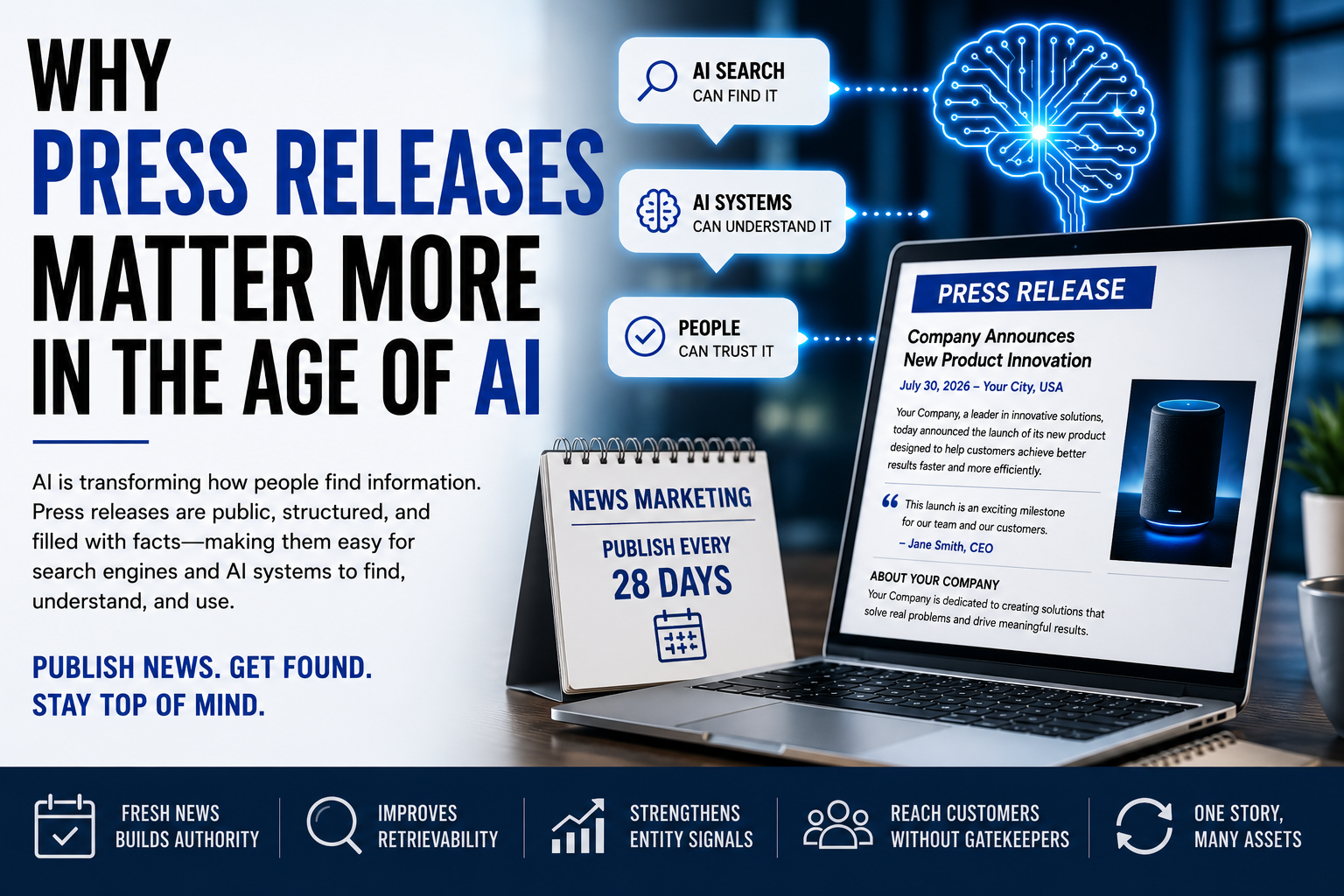
AI Doesn't Automatically Know What Happened Yesterday
There's a common misconception that ChatGPT and other large language models simply know everything that's on the internet.
They don't.
Think of an LLM as having a "frozen brain."
It was trained on an enormous amount of information, but that training happened at a point in time. New information isn't automatically absorbed into the model as soon as it appears online.
If your company launched a product yesterday, announced a partnership last week, opened a new location, released new research, or hired a new CEO, that information isn't magically stored inside the model.
So how can an AI assistant answer a question about something that happened yesterday?
It goes looking for it.
This Is Where RAG Comes In
The process is commonly called Retrieval-Augmented Generation, or RAG.
When an AI system needs current information, it can retrieve relevant information from available sources and use what it finds to help construct an answer.
Think about someone asking:
"What companies recently launched new products for employee mental wellness?"
An AI system doesn't necessarily answer that question solely from what it learned during training. It may need to find current information. It looks for relevant content, evaluates what it finds, and uses the most useful information to help generate its response.
That changes the marketing equation considerably.
The question is no longer simply:
How highly does my website rank?
Increasingly, another question matters:
Can an AI system find, understand, and retrieve information about my company when someone asks a relevant question?
That's retrievability.
And this is where the press release becomes much more interesting.
Press Releases Are Built for Retrieval
Think about what a well-written press release contains.
- It's public.
- It's timestamped.
- It's structured.
- It identifies companies, people, products, locations, and categories by name.
- It explains what happened and when.
- It contains factual, declarative statements.
- And once published on a stable, indexed URL, it can remain available for years.
Those characteristics happen to make press releases highly useful in a world where search engines and AI systems need to find and understand information.
A vague marketing paragraph saying, "We're excited to introduce an innovative solution that transforms the customer experience" doesn't tell a retrieval system very much.
Compare that with:
"Acme Corp launched Acme Benefits AI in August 2026, a new platform designed to help mid-sized employers analyze employee benefits utilization."
Now the system has a company, product, date, category, and purpose. That's information it can work with.
SEO Gets You Indexed. Retrieval Can Get You Into the Answer.
This is also why SEO and AI visibility shouldn't be viewed as completely separate strategies.
Search engines crawl and index the web. Good SEO practices help make your information findable, understandable, and authoritative. AI retrieval can then draw from that living library of information when answering questions.
Put simply:
SEO helps get your information into the library.
AI retrieval determines whether that information is useful enough to pull off the shelf when someone asks a question.
If your information isn't published or indexed, there may be nothing to retrieve.
If it is vague, outdated, or difficult to understand, it may not be useful for the question being asked.
But if it's current, specific, clearly structured, and associated with identifiable companies, products, people, and topics, you've created a much stronger retrieval asset.
Why Consistency Matters
One press release helps.
A consistent stream of meaningful news creates something much more valuable.
- Week one might announce a new product.
- Week two might explain an important development in your industry.
- Week three might announce a partnership.
- Week four might publish proprietary data.
- Week five might highlight a customer result.
Those aren't simply five press releases.
They're five fresh, dated signals connecting your company with the topics and categories you want to be known for.
Over time, those signals begin to stack.
This is the thinking behind the 28-Day Rule: publish at least one legitimate, well-structured piece of company news approximately every 28 days. More if you can.
Why? Because freshness matters. New information gets indexed. AI systems have something current to retrieve. Your company continues producing new connections between its name and the topics relevant to its business.
Then the cycle repeats.
The goal isn't to manufacture news. It's to recognize and publish the legitimate news most active companies already create.
One Release Should Become Many Assets
The press release also shouldn't be the finish line. It should be the source document.
One announcement can become an article, FAQ, LinkedIn post, social content, audio briefing, video, blog post, and content on your own website.
Every placement creates another surface where people, search engines, and AI systems can encounter and understand the information.
Instead of asking your marketing team to continually invent unrelated content, start with a much simpler question:
What happened that is new, specific, and true?
Publish that first. Then build outward from it.
This Is News Marketing
Traditional PR still matters. Journalists, relationships, earned media, and coverage remain valuable.
News Marketing is different.
It treats the press release not simply as a tool for getting a reporter's attention, but as a persistent digital asset designed to be discovered by customers, search engines, AI systems, and media.
Success isn't only how many endpoints received the release or how many theoretical impressions it generated. The bigger question is whether your company is becoming more findable.
- Are your pages indexed?
- Are your facts retrievable?
- Are AI systems beginning to associate your company with the topics you want to own?
- Does current information about your company exist when someone goes looking for it?
That's the opportunity AI has created for the press release.
Find something legitimate to say. Write it clearly. Publish it where it can be indexed. Turn it into multiple assets. Then do it again.
Because in an internet increasingly organized around answers instead of links, being online isn't enough.
You need to be findable.