Michael Shear Pitches Distributed Office Networks to Tame Austin's Commute Crisis
Strategist Michael Shear joins host Justin McKenzie to argue that fiber networks, edge computing, and distributed office hubs from Austin to Luling to Cedar Park could replace downtown high-rises, ease I-35 congestion, and reshape the future of work across Central Texas.
Austin, TX (Newsworthy.ai) Friday May 29, 2026 @ 8:00 AM CDT
Strategic Office Networks
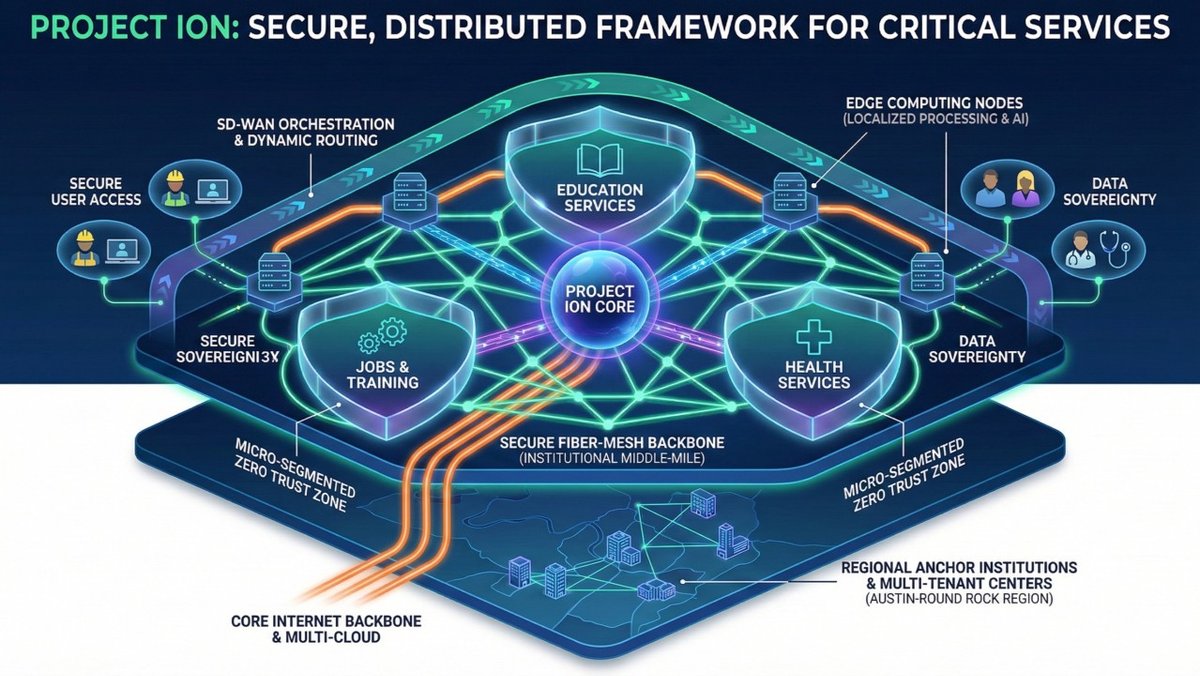
Photo: Project Ion - Strategic Office Networks
“You can come to our community and we have these highly networked centers and over 70 employers that are part of the networks so that as your job changes with an employer, you don't have to change communities.”
This recent episode of The Building Texas Show, titled 'The Future of Work in Texas: Distributed Offices, Fiber Networks & Ending Commutes,' was published on March 9th, 2026. It features host Justin McKenzie in Central Texas with strategist Michael Shear, leader of Strategic Office Networks. The conversation challenges the downtown high-rise model, exploring how regional growth, housing affordability, and I-35 congestion can be addressed with a regional fiber backbone, edge computing, and a strategically distributed workforce. The newsworthy claim: the infrastructure decisions Texas planners make in the next 12 to 24 months will define commuting, housing, and resilience for the next 100 years.
Across the hour, Shear and McKenzie unpack a specific vision he calls Project ION and a set of practical topic threads listeners can expect:
Strategic Office Networks
Photo: Project Ion - Strategic Office Networks
“You can come to our community and we have these highly networked centers and over 70 employers that are part of the networks so that as your job changes with an employer, you don't have to change communities.”
- Replacing one 60-floor downtown tower with ten six-floor office buildings sited in suburbs and exurbs like Cedar Park and Luling.
- Architecting dedicated, secure communications networks for hospitals, universities, chip manufacturers, and emergency dispatch, not just generic broadband.
- Pairing edge computing with the Texas data center boom to harden communities against climate events, accidents, and geopolitical risk on a high-value I-35 corridor.
Shear describes this as a structural transition, not just a remote-work debate. Referencing the 2026 book 'Overbuilt: The High Cost and Low Rewards of US Highways,' he notes that 22% of land in 316 U.S. metro areas is paved, echoing the Texas Transportation Institute's warning that regions cannot build their way out of growth.
"We've essentially entombed ourselves in a 20th century model, and now we're looking at how do we break through that into another dimension," Shear tells McKenzie.
The deeper discussion connects workforce strategy to public safety and economic resilience. Shear describes meetings with fire and police chiefs about deployment readiness during evacuations, references Nobel-recognized economic research by Joel Mokyr on how hardened institutions stall innovation, and points to Central Texas assets, including the seat of state government, major R&D universities, military complexes, and semiconductor fabs, as both a competitive advantage and a high-value target. He also flags generational economics: where a 30-year career once matched a 30-year mortgage, today's three-to-five-year job tenures put homebuying at risk unless networked hubs let workers change employers without changing communities. He highlights a recent Christmas-parade live portal linking a Texas town to Ireland as a preview of XR, spatial acoustics, and haptic tools becoming mainstream within three to five years. He also confirms that Google Fiber crews were laying new lines outside his home during the week of taping.
About The Building Texas Show
Hosted by Justin McKenzie, The Building Texas Show travels the state to interview the builders, strategists, and civic leaders shaping what Texas will look like over the next 50 years. Each episode connects infrastructure, technology, workforce, and community with the practical realities of explosive growth. The episode with Michael Shear is available now wherever podcasts are heard, and on YouTube; listeners are encouraged to like and subscribe.
Frequently Asked Questions
- What is Strategic Office Networks and the Project ION vision Michael Shear discusses?
- Strategic Office Networks, led by Michael Shear, advocates building a regional fiber-optic backbone and distributed office hubs across Central Texas rather than concentrating workers in downtown towers. The Project ION vision pairs dedicated communications networks, edge computing, and networked suburban and exurban office centers so workers can live within five to ten minutes of work while serving global organizations.
- Why does Shear argue Texas can't simply build more highways to handle growth?
- Shear cites the 2026 book Overbuilt: The High Cost and Low Rewards of US Highways, which found that across 316 U.S. metro areas roughly 22% of landmass has been paved over the most expensive real estate available. He echoes the Texas Transportation Institute's long-running conclusion that regions cannot build their way out of growth-driven congestion.
- How would a distributed office model change daily life for Central Texas families?
- Instead of one 60-floor downtown tower, Shear envisions ten six-floor buildings in communities like Cedar Park and Luling. That shift would put dual-income households closer to home, ease pressure on I-35, make soccer practice and family time feasible within a five-to-ten-minute bubble, and reduce the affordability squeeze pushing workers an hour or more from downtown Austin.
- Why does Shear connect workforce distribution to public safety and national security?
- He notes Central Texas concentrates state government, major R&D universities, military complexes, and chip manufacturing along the I-35 corridor, making the region a high-value target. Shear meets with fire and police chiefs because a pre-distributed workforce improves evacuation and crisis readiness, while edge computing reduces the vulnerability of centralized data processing to climate events, accidents, or geopolitical disruption.
- How do distributed hubs address the mismatch between modern job tenure and homeownership?
- Shear points out that 30-year careers once aligned with 30-year mortgages, but today's tenures average three to five years, putting home investments at risk. Networked community hubs hosting 70-plus employers would let workers change jobs without changing communities, restoring confidence to buy homes and stabilizing neighborhoods as the workforce churns.
- What emerging technologies does Shear say will make distributed work feel closer within three to five years?
- Beyond today's video tools like Skype, Shear points to XR (extreme reality) systems, full-size displays, spatial acoustics, and haptic response built into purpose-designed buildings. He cites a recent Christmas parade portal linking a Texas community to Ireland as an early glimpse of how these shelf-ready technologies can close the sense of distance between distributed offices.
Media Contact

Other Recent News for The Building Texas Show
- Beyond the Integration Tax: The idhubs Team is Rewiring the Business Operating System for the AI Era
- Fredericksburg High Students Raise $21K Launching Six Startups in INCubatoredu Debut
- From Jobsite to Pitmaster: Sloan Rinaldi's 1909 Texas BBQ Legacy
- San Marcos Buys 200 Acres to Extend Runway, Eyes Aerospace Future
- Why San Antonio Pool Buyers Are Ditching Concrete for Fiberglass