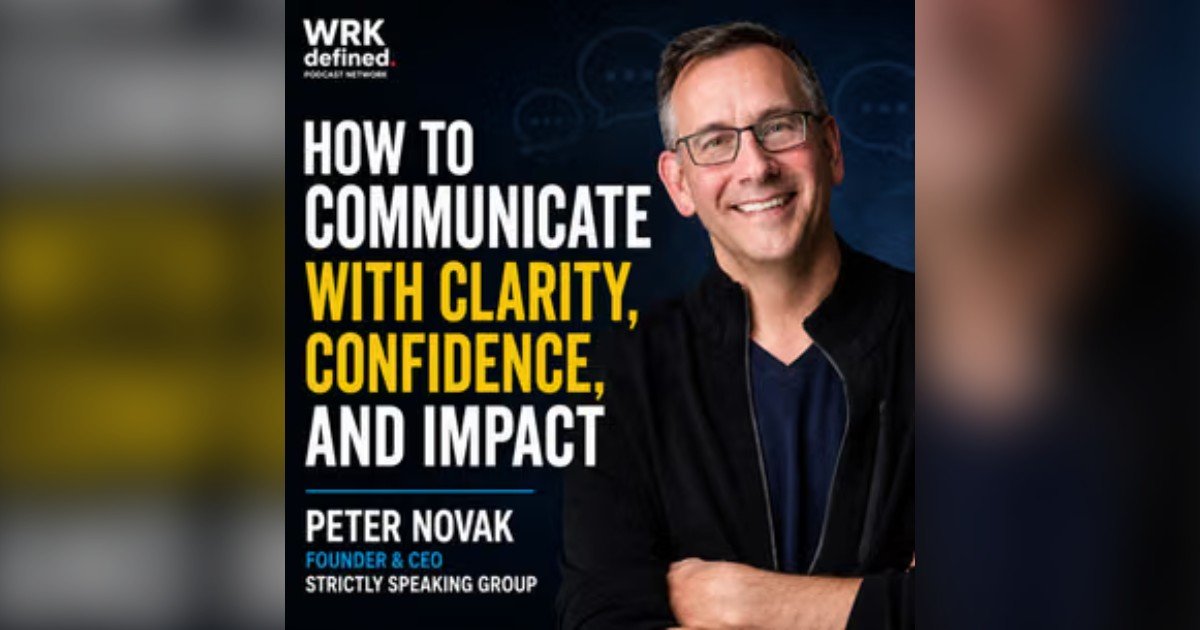
Peter Novak: Why Confidence Beats Perfect Grammar in Global Business English
On You Should Know, communications coach Peter Novak of Strictly Speaking Group unpacks how unconscious bias, phrasal verbs, and monolingual habits sabotage global teams, and why simplifying language is a business decision, not a diversity checkbox.





Fort Worth, TX (Newsworthy.ai) Monday Jul 13, 2026 @ 11:00 AM CDT

You Should Know — Mastering Global Communication: How to Communicate with Clarity, Confidence, and Impact
Photo: WRKdefined
“It's not an accent, it's an identity. No one should actually be forced to change their accent or feel that their accent is somehow inferior.”
The July 6, 2026 episode of You Should Know, the WRKdefined podcast on workplace leadership, features communications coach Peter Novak, founder of Strictly Speaking Group and a former 25-year professor at the University of San Francisco. Novak, who trained as a Jesuit, earned an MFA in acting and holds a doctorate in dramaturgy, joins host William to argue that strong workplace communication is not about bigger words or flawless English. It is about clarity, confidence, and trust across borders, an increasingly urgent skill as global teams grow more distributed.
Listeners get a working playbook for leading multilingual teams. Novak walks through several threads pulled from his coaching practice with executives at major corporations:
You Should Know — Mastering Global Communication: How to Communicate with Clarity, Confidence, and Impact
Photo: WRKdefined
“It's not an accent, it's an identity. No one should actually be forced to change their accent or feel that their accent is somehow inferior.”
- How unconscious bias, including the well-documented like-me bias, shapes who gets promoted and believed at work.
- Why phrasal verbs (take off, take up, take over, take down) quietly derail non-native English speakers, and how AI prompts can swap them for stronger, clearer verbs.
- What a McGill University study on foreign accents reveals about trust, credibility, and confident delivery.
- How investor relations teams now run CEO earnings calls through AI to score language choice and tone of voice.
Novak repeatedly reframes inclusive communication as a bottom-line issue rather than a political one. "The best way to position it is that this is a business issue, that you need your communication to be as clear as possible to everyone, not just to a select few," he tells the host. He also pushes back on the idea that non-native speakers are the ones who must adapt, invoking a Fred Astaire and Ginger Rogers analogy: "Ginger Rogers did everything Fred Astaire did, only backwards and in high heels." Non-native colleagues, he argues, are translating, interpreting, and vocabulary-hunting in real time while native speakers barrel ahead.
The conversation moves into concrete tactics. Novak describes building executive voiceprints by feeding hundreds of hours of transcripts into AI so leaders can deliver scripts that actually sound like them. He shares a 20-question intake he uses to help new executives tell their teams exactly how they want to be communicated with, from pre-reads to agenda formats. He references Yakov Smirnoff on the absurdity of English, contrasts Ernest Hemingway's accessibility with Oscar Wilde writing "for about 6 people," and notes that Latin American teams often operate trilingually in Spanish, Portuguese, and English until a monolingual American enters the room and collapses the exchange back to English. He also flags cultural intelligence lessons from his own preparation for business in Tokyo and Dubai.
About You Should Know
You Should Know is a WRKdefined podcast tackling the pivotal leadership challenges shaping the modern workplace. With a wide-ranging slate of guests and topics, it speaks to anyone invested in the evolving world of work, from frontline managers to global executives navigating culture, communication, and change. The episode featuring Peter Novak is available now wherever podcasts are heard.
Frequently Asked Questions
- Who is Peter Novak and what does Strictly Speaking Group do?
- Peter Novak is the founder of Strictly Speaking Group, a small communications coaching firm that works on high-stakes events for major corporations. A former 25-year professor at the University of San Francisco with an MFA in acting and a doctorate in dramaturgy, he trains coaches in his model and specializes in helping non-native English speakers deliver with the same confidence as native speakers.
- What did the McGill University study reveal about accent bias?
- The study asked whom you would trust for directions in an unfamiliar town: someone who sounds like you, or someone with a foreign accent. People tended to trust the speaker who sounded like them, a pattern Novak links to hiring's like-me bias. Crucially, the bias diminished and nearly disappeared when the foreign-accented speaker delivered their message with confidence.
- Why do phrasal verbs cause so much trouble for non-native English speakers?
- Phrasal verbs pair a verb with a preposition or adverb that completely changes the meaning. Novak points out that "take off" can mean removing a sweater, a plane departing, stopping antibiotics, telling someone to leave, or cutting a price. There are roughly 5,000 phrasal verbs in everyday English, forcing non-native listeners to interpret meaning in context on the fly.
- How is Novak using AI to help executives communicate more clearly?
- He builds a "DNA voiceprint" by feeding hundreds of hours of an executive's transcripts into AI to capture their syntax, favorite phrases, pacing, and tone, then generates scripts that actually sound like them. He also uses a global English prompt that removes phrasal verbs and substitutes stronger, clearer verbs, such as replacing "take off" with "soar."
- Why does Novak frame inclusive communication as a business issue rather than a political one?
- Novak argues that if a company calls itself global, clear communication to everyone, not a select few, is a bottom-line concern. He also notes investor relations teams now run quarterly earnings calls through AI to analyze executives' language choices against past performance and score their tone of voice for confidence, making communication quality directly material to how businesses are perceived.
- What happens on multilingual teams when a monolingual English speaker joins the room?
- Novak explains that Latin American teams often operate trilingually in Spanish, Portuguese, and English, asking more questions and giving each other more time to think. The moment a monolingual English speaker joins, the exchange collapses to English only, turn-taking accelerates, and the multilingual colleagues lose the linguistic flexibility that made their collaboration richer.
- What is the "helped, hugged, or heard" framework Novak mentions?
- Novak shares that his partner asks him whether he wants to be "helped, hugged, or heard" when he brings up something difficult, letting him name what he actually needs. He connects the shorthand back to executive communication: leaders also owe their teams clarity about how they want to be communicated with, which is why he runs a 20-question intake with new executives.
Media Contact

Other Recent News for You Should Know Podcast
- HiringBranch Study: Scoring Soft Skills Separately Weakens Frontline Hiring Predictions
- ServiceNow's John Phillips: Stop Measuring AI Adoption, Measure Work Outcomes
- Oyster Founder Tony Jamous: Fear-Based Leadership Is Quietly Sinking Companies
- Paper I-9s, AI Bias and $27K Fines: Where HR Compliance Breaks in 2026
- Burning Glass Study of 12M Workers Reveals Which Employers Actually Build Careers