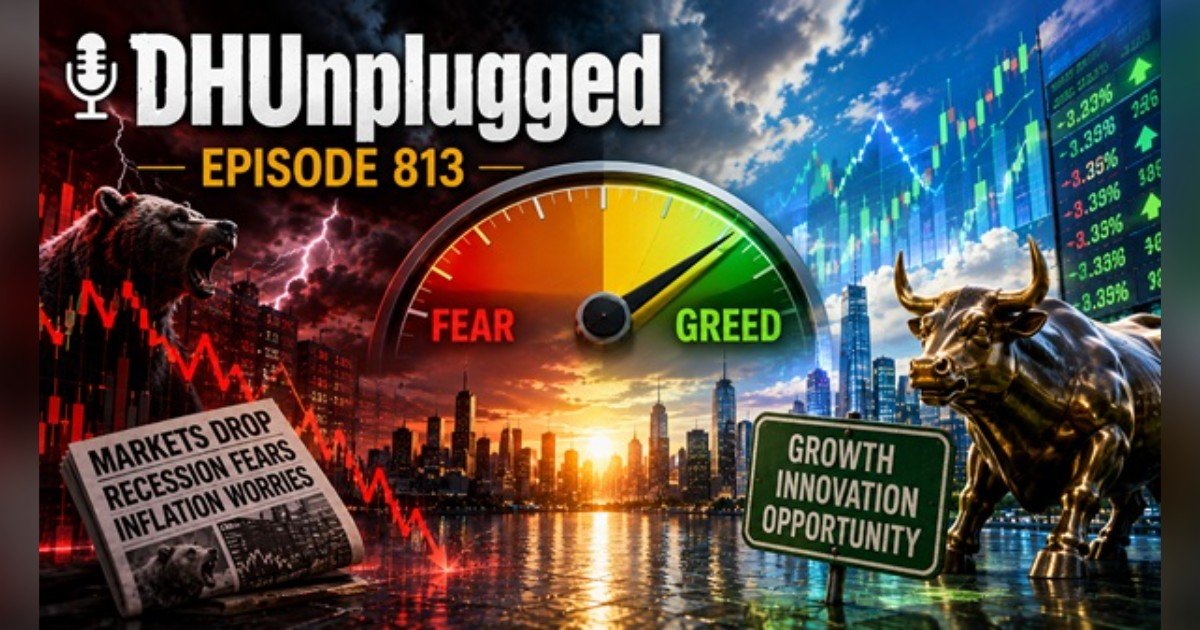
S&P 500 Surges to New Highs Amid Mixed Economic Signals
On Episode 813 of DHUnplugged, Andrew Horowitz and JC Dvorak dissect record market highs, a 90% earnings beat rate, the CNN Fear and Greed Index, mixed unemployment data, tariff whiplash, and mega-cap free cash flow swings at Apple, Meta, Amazon, and Nvidia.





Fort Lauderdale, FL (Newsworthy.ai) Wednesday Aug 12, 2026 @ 4:40 PM EDT
DH Unplugged — DHUnplugged #813: Fear and Greed
Photo: Horowitz and Dvorak
“When there's extreme greed is a time you want to start worrying. If there's extreme fear is when you want to start loading up the truck, backing up the truck, I call it.”
Episode 813 of DHUnplugged, titled Fear and Greed, published August 11, 2026 and hosted by Andrew Horowitz alongside JC Dvorak, tackles a market shaking off war, inflation, softening GDP, and tariff reversals to print new all-time highs. With roughly 80% of the S&P 500 already reported and nearly 90% beating EPS estimates, the hosts examine why investors are pricing in optimism ahead of Wednesday's CPI print and Thursday's PPI release, and whether the CNN Fear and Greed Index reading near 61 signals froth or a contrarian setup.
Horowitz and Dvorak walk listeners through several fast-moving threads shaping the tape this week:
DH Unplugged — DHUnplugged #813: Fear and Greed
Photo: Horowitz and Dvorak
“When there's extreme greed is a time you want to start worrying. If there's extreme fear is when you want to start loading up the truck, backing up the truck, I call it.”
- The Fear and Greed Index components, including Tom McClellan's Volume Summation Index and Horowitz's proprietary KRI (Key Reversal Indicator)
- Friday's jobs report: 4.1% unemployment, only 20,000 payrolls added, and a shrinking labor participation rate
- Oil's rebound after Scott Bessent's failed deal timeline, and a profitable client trade Horowitz doubled up on
- New 10 to 12% tariffs on 60 trading partners, 25-state lawsuits, and Nike's reported tariff refund
- Mega-cap free cash flow swings and Nvidia's $500 billion financing backstop
The conversation turns candid on behavioral finance, with Horowitz citing Daniel Crosby's work on loss aversion. "When people are freaking out, it's usually the time to get in. When people are like, oh my God, it's never gonna get worse, the market rally is gonna continue forever, it's like time to get out," Horowitz tells listeners. Dvorak pushes back, asking why proprietary signals used by shops like Jane Street stay private while retail-facing indicators become content. Horowitz's answer: "It's content. That's what it seems like to me at least."
Paragraph four goes deep on the mega-cap free cash flow picture that worried Horowitz heading into the quarter. Apple's free cash flow rose roughly $7.5 billion, or 31%, while Microsoft fell about $6 billion, Meta collapsed 91% on Mark Zuckerberg's renewed AI spending, Amazon swung $25 billion from positive $18 billion to negative $7.6 billion, Alphabet flipped negative, Tesla turned to a $1.09 billion outflow, and Intel worsened by $7.37 billion after a $20 billion secondary. Nvidia bucked the trend, adding $22.5 billion. The hosts also cover SoftBank's $2.2 billion quarterly profit driven by Masayoshi Son's Intel stake, ByteDance's OpenAI funding, and a heartfelt recap of the Fort Lauderdale meetup honoring the late John C. Dvorak, attended by roughly 35 listeners from across Florida.
About DH Unplugged
DH Unplugged is a weekly investing and markets podcast hosted by Andrew Horowitz and JC Dvorak that blends market commentary, economic news, business trends, and offbeat cultural observations with a skeptical, humorous tone. Episodes cover Fed policy, earnings, commodities, tech, and consumer trends. Episode 813 is available now on the DHUnplugged website, Apple Podcasts, Spotify, and Amazon Music/Podcasts.
Frequently Asked Questions
- What does the Fear and Greed Index reading near 61 actually mean for investors right now?
- On Episode 813, Horowitz characterizes the CNN Fear and Greed Index reading of 61 as being in the Greed zone but closer to neutral rather than extreme greed. He treats these indicators as contrarian signals, noting that extreme fear tends to be a buying opportunity and extreme greed a warning sign, but the current level does not yet warrant either action.
- Why did the July jobs report deliver 'something for everyone'?
- The report showed unemployment at 4.1%, one of the lowest readings in a long time, but only 20,000 new payrolls were added and the prior month was revised down by roughly 70,000. Horowitz explains the low unemployment rate was partly driven by a shrinking labor participation rate, meaning bulls and bears can each cite the data to support their view.
- How did mega-cap free cash flow shake out this earnings season?
- Apple's free cash flow rose about $7.5 billion or 31%, and Nvidia added $22.5 billion. But Microsoft fell $6 billion, Meta dropped 91% on renewed AI spending, Amazon swung $25 billion into negative territory, Alphabet flipped negative, Tesla turned to a $1.09 billion outflow, and Intel worsened by $7.37 billion after a $20 billion secondary offering.
- What is the KRI Index that Andrew Horowitz mentions?
- KRI stands for Key Reversal Indicator, a proprietary tool Horowitz built that combines multiple ranked, weighted indicators into a single reading. He says historically when the KRI bottoms out it has signaled a time to buy, though tops are less reliable as sell signals because investors react to fear faster than they react to greed.
- Why are investors seemingly ignoring the new 10 to 12% tariffs on 60 trading partners?
- Horowitz argues investors have grown numb after repeated tariff whiplash and now assume companies can navigate through them. He also notes some firms, like Nike, are receiving refunds that boost reported earnings, and management teams have used tariff pressure as cover to cut costs, similar to how COVID and AI narratives justified layoffs.
- What happened at the Fort Lauderdale meetup honoring John C. Dvorak?
- Roughly 35 listeners gathered in Fort Lauderdale, some driving from Miami, Tampa, St. Pete, and Port St. Lucie, with one attendee flying in from Maryland. Horowitz hosted JCD trivia, gave away signed copies of the Stock Market ABCs book illustrated by Jay Dvorak, and Adam Curry sent a video from San Francisco ahead of the funeral service.
- Why does the upcoming CPI print matter so much this week?
- CPI is expected to ease to 3.4% year over year with core at 2.5%, released Wednesday at 8:30 a.m., followed by PPI on Thursday. A soft reading could push the 10-year Treasury yield from around 4.6-4.7% back toward 4.4% and boost rate cut hopes, while a hot number could revive rate hike fears under Kevin Warsh.
Media Contact
Other Recent News for DHUnplugged Podcast
- Bessent's 'Counterfactual' Defense Draws Fire on DH Unplugged
- Bessent Declares 'I Am the House' as CPI, Oil Shock and Bond Yields Rattle Markets
- Oil Spikes, Bond Jitters and a Target Halloween Backlash Rattle September Markets
- Bessent's 'Big Bond Blunder' and 5 Dumb Finance Moves Rattling Markets
- Michael Burry Calls Another Top as Nvidia Turns Chips Into Collateral