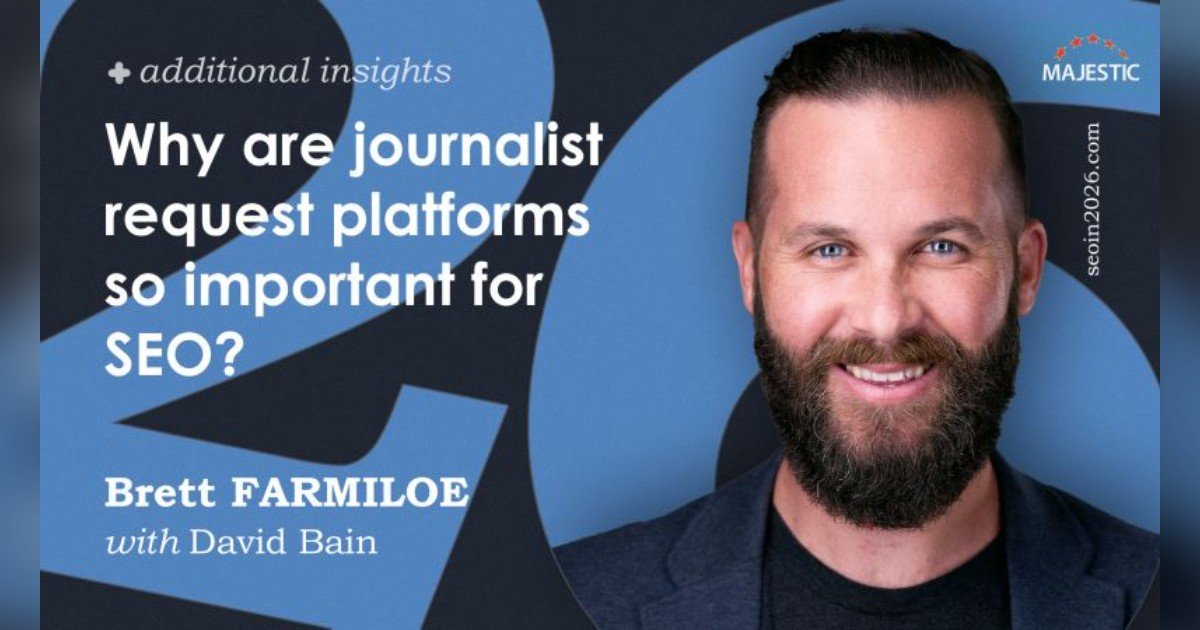
AI Has Made Media Pitching Noisier and Less Effective, Says Featured CEO Brett Farmiloe
The founder of Featured, which owns and operates HARO and Connectively, told Majestic's SEO in 2026 podcast that volume outreach has stopped working, and detailed the AI-detection scoring now applied to every pitch on both platforms.






Scottsdale, AZ (Newsworthy.ai) Saturday Aug 8, 2026 @ 9:00 AM EDT
"Less is more in 2026, in terms of being an outreach specialist," Farmiloe said. "What we've seen is that AI has made it incredibly easy to reach out to more people, and it's made it more noisy and less effective as a result."
Brett Farmiloe, founder and CEO of Featured, said the collapse in effectiveness of high-volume media outreach is now visible in platform data, in an interview on Majestic's SEO in 2026 podcast series.
"Less is more in 2026, in terms of being an outreach specialist," Farmiloe said. "What we've seen is that AI has made it incredibly easy to reach out to more people, and it's made it more noisy and less effective as a result."
"Less is more in 2026, in terms of being an outreach specialist," Farmiloe said. "What we've seen is that AI has made it incredibly easy to reach out to more people, and it's made it more noisy and less effective as a result."
Featured owns and operates HARO (Help a Reporter Out), the journalist request service running since 2008, and Connectively. The company has visibility across both sides of the exchange - the requests journalists post and the pitches sources send back.
Farmiloe said the pattern in that data is consistent. "The outreach that I'm seeing winning on our platforms is the folks who aren't sending out a higher volume of pitches, but they're sending out a higher quality of pitch."
He traced the quality problem directly to the acquisition that brought HARO under Featured's ownership. "The reason why HARO ended up in our ownership in the first place was a decline of quality and trust within the system, and a lot of that was targeted through the adoption of artificial intelligence."
The company's response was to make AI authorship visible rather than to prohibit it. "We run AI detection on every single pitch," Farmiloe said. "We'll run a quality score on every pitch that goes through our platform - whether that's HARO, whether that's Connectively - and we'll allow journalists to see those scores. If it's 100% AI-generated, the journalists will see that. They've got a one-click filter to opt out of those pitches entirely."
Farmiloe also challenged a widely held assumption about response speed. "It's not necessarily being the first in line, but it's being at the top of the line with the best credentials and the most helpful response," he said, describing a framework built on the HARO name - helpful, authentic, relevant and on time.
On measurement, he said the standard the market reports against is shifting. "In 2026, the metrics are changing. AI visibility scores are one thing that we're seeing more and more innovators measure against," Farmiloe said. "It's really around: Is my brand visible in AI and LLMs?" He described marketers moving their metrics "towards the new front page of the internet."
Asked what practitioners should take from the conversation, Farmiloe pointed away from tactics. "The key takeaway is that you have knowledge to share, and that knowledge is highly valued by journalists and publications. Find a way to share that knowledge, and if you share your knowledge in a meaningful way, it will benefit your business."
The full episode and transcript are available at https://majestic.com/seo-in-2026/additional-insights/brett-farmiloe.
Frequently Asked Questions
- What is a journalist request platform?
- A service where reporters post what they need for a story and expert sources respond. As Farmiloe described it: "Journalists need sources for stories and, oftentimes, when they don't have the Rolodex to satisfy a particular story, they'll turn to a journalist request platform with a particular request." Sources who are selected are typically quoted with attribution.
- Who owns HARO?
- Featured owns and operates HARO (Help a Reporter Out), which has connected journalists with sources since 2008 and sends three daily emails of journalist requests. Featured also owns and operates Connectively.
- Does HARO detect AI-written pitches?
- Yes. Featured runs an AI-detection quality score on every pitch submitted through HARO and Connectively, and shows that score to journalists. Journalists can filter out fully AI-generated pitches in one click.
- How is Featured different from HARO and Connectively?
- HARO is an email service and Connectively is a searchable platform, both centered on journalist requests. Featured goes wider — byline article opportunities, journalists to pitch, speaking opportunities, awards, and a directory of more than 814,000 active podcasts to pitch.
- How often should someone check a journalist request platform?
- Farmiloe recommends a daily habit over periodic sprints: "It's almost like working out. It's something that we've seen a lot of our customers calendar 15 minutes every single day to, just to see what the latest is."
Media Contact

Other Recent News for Featured
- One in Three Journalists Now Filter Out AI-Written Pitches, Says Featured CEO Brett Farmiloe
- Featured.com Acquires Help A Reporter Out (HARO) from Cision
- Introducing SmallBizLeader.com: A Destination for Small Business Leaders Worldwide
- Gardening.guru Blooms Online: A Premium Hub for Horticulture Enthusiasts and Experts
- MergerAcquisition.io Debuts: Platform for M&A Insights and Expertise